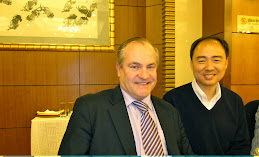
On Wednesday December 12, Professor Zhao Huiyu, Maryland’s visiting environmental law scholar from Shanghai Jiaotong Law School, and I visited the Federal Maritime Commission (FMC) in Washington, D.C. The FMC is an independent agency responsible for regulating maritime shipping to and from the United States. We observed a meeting of the five-member Commission, which is chaired by Richard Lidinsky, Jr. The Commission voted on a number of matters, including extending an existing exemption on filings of negotiated rate agreements by non-vessel-operating common carriers to foreign carriers, and its staff provided a briefing on the use of alternative dispute resolution in enforcement proceedings. Professor Zhao was quite impressed by the openness of the process, noting that in China one would never see government officials openly airing policy disagreements in public. Following the commission meeting Professor Zhao and I met with Chairman Lidinsky in his offices and we then joined him and his staff for lunch.
The vast majority of imports into the U.S. arrive by ship and China is the leading country of origin of such shipments. As a result, FMC officials regularly consult with their Chinese counterparts and they rotate holding annual meetings in one country or the other. The shipping industry has become much more environmentally conscious in recent years, something that Chairman Lidinsky has sought to encourage by giving the Chairman’s Earth Day Award annually to recognize outstanding leadership and innovation in sustainable ocean transport practices. Nike won the award this year for reducing the carbon footprint of its shipping. Previous award winners have included the Maersk Line for environmental leadership in vessel operation, vessel design, and efforts to increase carbon emissions transparency and the Port of Los Angeles for air quality improvements from its Clean Truck program.
On Friday December 14 the Atlantic States Marine Fisheries Commission voted to impose a historic limit on the catch of menhaden. These small fish, which are a critical part of the food chain in the Chesapeake Bay region, have declined to less than one-fifth of the population that existed during the 1960s. An excellent film about the menhaden, which was made by my Environmental Law students last year, can be seen online at: http://digitalcommons.law.umaryland.edu/envirofilms/42. At a raucous public meeting in Baltimore, the Commission voted 13-3 to limit next year’s menhaden catch to 170,800 metric tons, a 20 percent reduction below average levels during the past three years. While this reduction was less than what had been recommended by environmental groups, Virginia officials protested that it would devastate the state’s fishing industry, which is responsible for 80 percent of the menhaden catch. Much of the Virginia catch is for Omega Protein, a corporation that processes the fish for fish oil and fishmeal.
In order to meet a court-ordered deadline, the U.S. Environmental Protection Agency (EPA) announced on Friday December 14 that it had strengthened its national ambient air quality standard (NAAQS) for fine particulates (PM 2.5) including soot. EPA set an annual standard of 12 micrograms per cubic meter of air. The agency estimates that by 2030 the new standard will prevent up to 40,000 premature deaths, 32,000 hospital admissions, and 4.7 million work days lost due to illness. EPA estimates that the new standard will produce net benefits ranging from $3.6 billion to $9 billion per year. While some industry groups criticized EPA for strengthening the standard, EPA noted that less than ten of the 30,000 counties in the U.S. will have to undertake new local regulations to meet the standard. A video of EPA Administrator Lisa Jackson describing the new standards is online at: http://www.youtube.com/watch?v=CEUrnDB2rF0&feature=youtu.be
While my students were taking their Administrative Law and Environmental Law exams last week, my wife and I made our annual pre-Christmas pilgrimage to Manhattan. On Monday December 10 we went to Greenwich Village to see the opening run of “Happy New Year,” a powerful film about the plight of veterans returning from Iraq and Afghanistan, for which my nephew is one of the executive producers. Prior to arriving at The Quad where the film was showing, we stumbled upon the MLB Fan Cave where Cobie Caillat was giving a free concert. On December 11 we had lunch at Le Bernardin to celebrate the second anniversary of my wife’s cancer being in total remission and that evening we attended the performance of “The Messiah” by the St. Thomas Men and Boys Choir and Concert Royal. On December 12 I took the 6AM Acela back to D.C. and met Professor Zhao at Union Station just in time for our visit to the Federal Maritime Commission, whose offices are just a few blocks away.
Monday, December 17, 2012

Monday, December 10, 2012
COP18 Concludes, China Air Pollution Plan, Stormwater in the U.S. Supreme Court, Tesla S (By Bob Percival)
The 18th Conference of the Parties to the UN Framework Convention on Climate Change (COP18) held in Doha, Qatar concluded at the end of last week after a marathon 36-hour final session that ran long past its scheduled conclusion. A total of 37 countries, primarily from the European Union, agreed to extend their Kyoto Protocol commitments to control emissions of greenhouse gases (GHGs) through the year 2020. The existing Kyoto commitment period expires at the end of 2012. New Zealand, Canada, Russia and Japan decided to opt out of extending their Kyoto commitments. Thus, after 2012 the Protocol will only cover countries that are responsible for less than 15 percent of global emissions of GHGs. Australia, which initially had joined the U.S. in rejecting the Kyoto Protocol, but which subsequently ratified it, also agreed to the extension to 2020, citing a desire to participate in the EU carbon trading market.
A particularly contentious set of issues at Doha were negotiations over the fund to help developing countries deal with climate change. Citing current economic problems, the U.S. and the EU refused to set precise figures for contributions to the fund during the period from 2013-2020. At Copenhagen in 2009 developed countries had promised to establish a green fund and to fund it at $100 billion/year by 2020. Some observers viewed the shift in the tone of the discussion from using the fund to assist developing countries with mitigation and adaptation toward using it to compensate them for “loss and damage” caused by the developed world as setting the stage for more conflict in future climate talks. The Durban Platform for completing by 2015 a new agreement to control global GHG emissions by the year still is in place, but there is considerable skepticism as to whether this goal will be achieved. At COP18 Xia Zhenhua, head of the Chinese delegation, stated that China would be willing to discuss adopting binding GHG emissions limits that would be effective after 2020.
On December 5 China’s Ministry of Environmental Protection released a plan pledging to reduce air pollutants in 13 major areas covering 117 cities in China. The plan seeks to reduce PM2.5 intensity by 5 percent by 2015 and to reduce the intensity of PM10 and sulfur dioxide by 10 percent by 2015. It also pledges a 7 percent reduction in the intensity of nitrogen dioxide emissions. The plan includes a requirement that new sources of air pollution offset their pollution by obtaining larger reductions in the same kind of pollution from existing sources. Earlier this year China’s State Council enacted new air quality standards that include for the first time the smallest particulates (PM2.5) and ozone. These are to be met throughout the nation by January 1, 2016. It is estimated that 70 percent of China’s cities currently do not meet the revised standards.
Last week the U.S. Supreme Court heard oral argument in two cases involving the Clean Water Act. In both cases the U.S. Court of Appeals for the Ninth Circuit had ruled in favor of environmental interests. On Monday December 3 the Court heard argument in Decker v. Northwestern Environmental Defense Center, a case involving the question whether timber companies need Clean Water Act permits to control stormwater runoff from logging operations that flows through ditches and culverts along logging roads. Three days before the argument the U.S. Environmental Protection Agency (EPA) promulgated new regulations that purported to reverse the Ninth Circuit’s decision by clarifying that these were not the type of silvicultural operations that required a stormwater permit. Chief Justice Roberts expressed irritation that the Court had not been given more notice about the impending regulations, though the Solicitor General initially had advised the Court not to take the case because EPA would resolve the issue through regulations.
Professor Jeffrey Fisher, co-director of Stanford’s Supreme Court Litigation Clinic, argued that the Court should dismiss the cert petition as improvidently granted in light of the fact that the environmental groups would be challenging the new regulations as inconsistent with the Clean Water Act. Tim Bishop, arguing for the timber industry said the Court should prevent years of further litigation by reversing the Ninth Circuit and agreeing with EPA that permits are not needed. Following the argument students from my Environmental Law and Administrative Law classes came over to my house on Capital Hill for lunch and a post-mortem on the argument.
On Tuesday December 4 the Court heard Los Angeles County Flood Control District v. Natural Resources Defense Council. In this case the argument focused not on whether the stormwater discharges required a permit, but rather how to measure permit violations and who should be responsible for them. Under the District’s permit, monitoring stations have been placed where water flows within the storm sewer system rather than where it discharges to another body of water. Some observers thought the Court could use the case to clarify its prior Miccosukee decision where it indicated that water transfers within a single body of water were not discharges requiring a permit. I was unable to attend the argument, but the transcript of it suggests that it is not clear how the Court will rule.
On December 7 I finally took the plunge and placed my order for an all-electric Tesla Model S automobile. Last February the University of Maryland installed four electric vehicle charging stations at our parking garage, but they have been largely unused, except for a rare appearance by a Chevy Volt. My Prius will be seven years old next summer and have more than 100,000 miles on it and I was in the market for an electric car. Tesla opened a showroom in downtown DC not far from my home and last month its Model S won the award as Motor Trends “Car of the Year” for 2012. While some electric vehicle manufacturers are struggling, Tesla has produced a spectacular luxury vehicle that is now coming off its Fremont, California assembly line at the rate of 400 cars per week. The company reports that it recently turned cash flow positive for the first time. I am now in line for #15,443 of the Model S so it won’t be delivered to me until fall 2013, but what a car it is.
A particularly contentious set of issues at Doha were negotiations over the fund to help developing countries deal with climate change. Citing current economic problems, the U.S. and the EU refused to set precise figures for contributions to the fund during the period from 2013-2020. At Copenhagen in 2009 developed countries had promised to establish a green fund and to fund it at $100 billion/year by 2020. Some observers viewed the shift in the tone of the discussion from using the fund to assist developing countries with mitigation and adaptation toward using it to compensate them for “loss and damage” caused by the developed world as setting the stage for more conflict in future climate talks. The Durban Platform for completing by 2015 a new agreement to control global GHG emissions by the year still is in place, but there is considerable skepticism as to whether this goal will be achieved. At COP18 Xia Zhenhua, head of the Chinese delegation, stated that China would be willing to discuss adopting binding GHG emissions limits that would be effective after 2020.
On December 5 China’s Ministry of Environmental Protection released a plan pledging to reduce air pollutants in 13 major areas covering 117 cities in China. The plan seeks to reduce PM2.5 intensity by 5 percent by 2015 and to reduce the intensity of PM10 and sulfur dioxide by 10 percent by 2015. It also pledges a 7 percent reduction in the intensity of nitrogen dioxide emissions. The plan includes a requirement that new sources of air pollution offset their pollution by obtaining larger reductions in the same kind of pollution from existing sources. Earlier this year China’s State Council enacted new air quality standards that include for the first time the smallest particulates (PM2.5) and ozone. These are to be met throughout the nation by January 1, 2016. It is estimated that 70 percent of China’s cities currently do not meet the revised standards.
Last week the U.S. Supreme Court heard oral argument in two cases involving the Clean Water Act. In both cases the U.S. Court of Appeals for the Ninth Circuit had ruled in favor of environmental interests. On Monday December 3 the Court heard argument in Decker v. Northwestern Environmental Defense Center, a case involving the question whether timber companies need Clean Water Act permits to control stormwater runoff from logging operations that flows through ditches and culverts along logging roads. Three days before the argument the U.S. Environmental Protection Agency (EPA) promulgated new regulations that purported to reverse the Ninth Circuit’s decision by clarifying that these were not the type of silvicultural operations that required a stormwater permit. Chief Justice Roberts expressed irritation that the Court had not been given more notice about the impending regulations, though the Solicitor General initially had advised the Court not to take the case because EPA would resolve the issue through regulations.
Professor Jeffrey Fisher, co-director of Stanford’s Supreme Court Litigation Clinic, argued that the Court should dismiss the cert petition as improvidently granted in light of the fact that the environmental groups would be challenging the new regulations as inconsistent with the Clean Water Act. Tim Bishop, arguing for the timber industry said the Court should prevent years of further litigation by reversing the Ninth Circuit and agreeing with EPA that permits are not needed. Following the argument students from my Environmental Law and Administrative Law classes came over to my house on Capital Hill for lunch and a post-mortem on the argument.
On Tuesday December 4 the Court heard Los Angeles County Flood Control District v. Natural Resources Defense Council. In this case the argument focused not on whether the stormwater discharges required a permit, but rather how to measure permit violations and who should be responsible for them. Under the District’s permit, monitoring stations have been placed where water flows within the storm sewer system rather than where it discharges to another body of water. Some observers thought the Court could use the case to clarify its prior Miccosukee decision where it indicated that water transfers within a single body of water were not discharges requiring a permit. I was unable to attend the argument, but the transcript of it suggests that it is not clear how the Court will rule.
On December 7 I finally took the plunge and placed my order for an all-electric Tesla Model S automobile. Last February the University of Maryland installed four electric vehicle charging stations at our parking garage, but they have been largely unused, except for a rare appearance by a Chevy Volt. My Prius will be seven years old next summer and have more than 100,000 miles on it and I was in the market for an electric car. Tesla opened a showroom in downtown DC not far from my home and last month its Model S won the award as Motor Trends “Car of the Year” for 2012. While some electric vehicle manufacturers are struggling, Tesla has produced a spectacular luxury vehicle that is now coming off its Fremont, California assembly line at the rate of 400 cars per week. The company reports that it recently turned cash flow positive for the first time. I am now in line for #15,443 of the Model S so it won’t be delivered to me until fall 2013, but what a car it is.
Sunday, December 2, 2012
COP18 in Doha, Myanmar Mine Protest, Poultry Pollution Suit, E-Law Films (by Bob Percival)
The Eighteenth Conference of the Parties (COP18) to the UN Framework Convention on Climate Change (UNFCCC) and the Eighth Meeting of the Parties to the Kyoto Protocol (CMP8) are underway in Doha, Qatar. It seems ironic that the conference is being held in Qatar, the country that is the world’s leader in per capita emissions of greenhouse gases (GHGs). As host of the 2022 football/soccer World Cup Qatar has pledged to air condition the outdoor stadiums that will be used for soccer’s premier event, though the electricity running the air conditioning supposedly will be generated by solar power. COP18 will run through next Friday December 7 and, as is usual with these events, most of the important decisions are likely to be made at the very end. There are 195 nations who are parties to the UNFCCC. On the agenda are a second round of commitments to the Kyoto Protocol, whose existing commitment period expires at the end of this year, and efforts to flesh out the outlines of a new global climate agreement to be finalized by 2015.
On November 29 government security forces in Myanmar violently attacked citizens protesting the expansion of a copper mine near the city of Monywa. The mine is owned jointly by a Chinese company and the Burmese military’s Union of Myanmar Economic Holdings. The security forces fired explosive devices and severely injured many of the protesters who included numerous monks. According to the protesters, expansion of the mine would displace the residents of more than twenty villages and cause severe environmental damage. Myanmar opposition leader Aung San Suu Kyi arrived at the site after the crackdown and agreed to participate in an investigation of what happened.
Last Wednesday I attended a farewell party in U.S. Attorney General Eric Holder’s office for my casebook co-author Chris Schroeder who is stepping down as Assistant Attorney General for the Office of Legal Policy. It was a wonderful event with warm remarks from Chris, Attorney General Holder, Deputy Attorney General Jim Cole, former acting Solicitor General Walter Dellinger and others. Chris will return to teaching at Duke next semester when we will be publishing the new seventh edition of our Environmental Regulation: Law, Science & Policy casebook.
On Friday I attended closing arguments in federal district court in Baltimore in the Waterkeeper Alliance’s landmark lawsuit against Hudson Farms and Perdue for poultry waste pollution of the Chesapeake Bay. The arguments followed briefing of proposed findings of fact and conclusions of law after a trial that spanned parts of three weeks. The basic issue in the case is whether a poultry CAFO with 40,000 birds violated the Clean Water Act by discharging poultry waste into a tributary of a river flowing into the Chesapeake Bay. The lawsuit was filed in March 2010. The University of Maryland’s Environmental Law Clinic is representing the Waterkeepers. In an important early victory for the Clinic Judge Nickerson denied Perdue’s motion to dismiss it as a defendant, holding that poultry integrators can be held liable for Clean Water Act violations by their contractor’s CAFO if they exercise sufficient control over their contractor’s chicken operations. Assateague Coastkeeper v. Hudson Farm, 727 F. Supp. 2d 433 (D.Md. 2010). The focus of the trial is now on whether the defendant’s CAFO did in fact discharge pollutants in violation of the Clean Water Act.
Last week was the end of classes for the fall semester at Maryland. Every year I have students in my Environmental Law class form small groups to make short documentary films about an environmental issue they are concerned about. Last Monday on the last day of class the students showed the first cut of their films. There are nine films this year. The topics of the films include: invasive species and ballast water, the impact of climate change on the wine industry, hydraulic fracturing, the work of the Baltimore Harbor Riverkeeper, offshore wind in Maryland, the impact of methamphetamine labs on the environment, oysters and the Chesapeake Bay, urban composting, and municipal climate action. The students have until February 1 to submit the final cuts of their films that will be submitted to a panel of judges. On March 27 we will be holding the annual “Golden Tree” award ceremony for the films. The films will then be made available for viewing online.
On November 29 government security forces in Myanmar violently attacked citizens protesting the expansion of a copper mine near the city of Monywa. The mine is owned jointly by a Chinese company and the Burmese military’s Union of Myanmar Economic Holdings. The security forces fired explosive devices and severely injured many of the protesters who included numerous monks. According to the protesters, expansion of the mine would displace the residents of more than twenty villages and cause severe environmental damage. Myanmar opposition leader Aung San Suu Kyi arrived at the site after the crackdown and agreed to participate in an investigation of what happened.
Last Wednesday I attended a farewell party in U.S. Attorney General Eric Holder’s office for my casebook co-author Chris Schroeder who is stepping down as Assistant Attorney General for the Office of Legal Policy. It was a wonderful event with warm remarks from Chris, Attorney General Holder, Deputy Attorney General Jim Cole, former acting Solicitor General Walter Dellinger and others. Chris will return to teaching at Duke next semester when we will be publishing the new seventh edition of our Environmental Regulation: Law, Science & Policy casebook.
On Friday I attended closing arguments in federal district court in Baltimore in the Waterkeeper Alliance’s landmark lawsuit against Hudson Farms and Perdue for poultry waste pollution of the Chesapeake Bay. The arguments followed briefing of proposed findings of fact and conclusions of law after a trial that spanned parts of three weeks. The basic issue in the case is whether a poultry CAFO with 40,000 birds violated the Clean Water Act by discharging poultry waste into a tributary of a river flowing into the Chesapeake Bay. The lawsuit was filed in March 2010. The University of Maryland’s Environmental Law Clinic is representing the Waterkeepers. In an important early victory for the Clinic Judge Nickerson denied Perdue’s motion to dismiss it as a defendant, holding that poultry integrators can be held liable for Clean Water Act violations by their contractor’s CAFO if they exercise sufficient control over their contractor’s chicken operations. Assateague Coastkeeper v. Hudson Farm, 727 F. Supp. 2d 433 (D.Md. 2010). The focus of the trial is now on whether the defendant’s CAFO did in fact discharge pollutants in violation of the Clean Water Act.
Last week was the end of classes for the fall semester at Maryland. Every year I have students in my Environmental Law class form small groups to make short documentary films about an environmental issue they are concerned about. Last Monday on the last day of class the students showed the first cut of their films. There are nine films this year. The topics of the films include: invasive species and ballast water, the impact of climate change on the wine industry, hydraulic fracturing, the work of the Baltimore Harbor Riverkeeper, offshore wind in Maryland, the impact of methamphetamine labs on the environment, oysters and the Chesapeake Bay, urban composting, and municipal climate action. The students have until February 1 to submit the final cuts of their films that will be submitted to a panel of judges. On March 27 we will be holding the annual “Golden Tree” award ceremony for the films. The films will then be made available for viewing online.
Tuesday, November 27, 2012
U.S./Mexico Colorado River Agreement, California GHG Allowance Auction, EU Suspends Aviation GHG Emissions Fee, Wilson Center China PIL Program (by Bob Percival)
On November 20 the governments of the U.S. and Mexico signed an historic agreement governing how they will share water from the Colorado River during the next five years. Mexico agreed to reduce its share of the water during drought conditions in return for an increased share of water in times when it is more abundant. Mexican farmers will be paid to give up three percent of their water allotment with the loss to be made up through improvements that will reduce leakage from their irrigation canals. Regional water agencies in Arizona, Nevada and Southern California will be purchasing 100,000-acre feet of water from Mexico. The agreement also includes a pilot program of water releases that are designed to restore wetlands in Northern Mexico that once had been an important habitat for migratory birds.
On November 19 the California Air Resources Board reported the results of its first quarterly auction of greenhouse gas (GHG) allowances under the state’s cap-and-trade program to combat global warming and climate change. More than seventy entities were qualified as bidders to participate in the auction. All 23,126,110 metric tons of vintage 2013 allowances that were offered for sale were sold at the auction. The settlement price per allowance was $10.09 per metric ton, slightly above the minimum auction reserve price of $10.00. Details of the auction are available at CARB’s website at: http://www.arb.ca.gov/cc/capandtrade/auction/november_2012/auction1_results_2012q4nov.pdf. A last minute lawsuit filed by the California Chamber of Commerce that claimed that the auction was a tax CARB had not been authorized to levy failed to stop the auction.
Airlines continued to hail the EU’s decision to suspend the January 1, 2013 date when foreign airlines flying to and from the EU were to be required to pay GHG emissions charges. The suspension was undertaken in order to give the International Civil Aviation Organization (ICAO) an opportunity to negotiate a global agreement. The EU warned that if the ICAO fails to make progress toward reaching a global agreement it will reinstate the charges. Legislation giving the U.S. Secretary of Transportation the authority to prohibit U.S. airlines from paying the charges was signed into law by President Obama today.
On November 27 I participated in a panel on public interest environmental litigation in China at the Woodrow Wilson Center for International Scholars in Washington. The program was sponsored by the Wilson Center’s China Environment Forum. Also on the panel were Jingjing Liu from Vermont Law School and Jessica Scott from the U.S. Environmental Protection Agency, who spoke about current environmental litigation in China by public interest groups, including the All China Environment Federation. I focused on the amendments to Article 55 of China’s Civil Procedure Code which cryptically authorizes environmental public interest litigation by agencies and other related groups as authorized by law. A tape of the presentation and copies of the slides will be placed online by the Wilson Center. See http://www.wilsoncenter.org/event/the-people’s-interest-openings-for-pollution-public-interest-law-cases-china.
On November 19 the California Air Resources Board reported the results of its first quarterly auction of greenhouse gas (GHG) allowances under the state’s cap-and-trade program to combat global warming and climate change. More than seventy entities were qualified as bidders to participate in the auction. All 23,126,110 metric tons of vintage 2013 allowances that were offered for sale were sold at the auction. The settlement price per allowance was $10.09 per metric ton, slightly above the minimum auction reserve price of $10.00. Details of the auction are available at CARB’s website at: http://www.arb.ca.gov/cc/capandtrade/auction/november_2012/auction1_results_2012q4nov.pdf. A last minute lawsuit filed by the California Chamber of Commerce that claimed that the auction was a tax CARB had not been authorized to levy failed to stop the auction.
Airlines continued to hail the EU’s decision to suspend the January 1, 2013 date when foreign airlines flying to and from the EU were to be required to pay GHG emissions charges. The suspension was undertaken in order to give the International Civil Aviation Organization (ICAO) an opportunity to negotiate a global agreement. The EU warned that if the ICAO fails to make progress toward reaching a global agreement it will reinstate the charges. Legislation giving the U.S. Secretary of Transportation the authority to prohibit U.S. airlines from paying the charges was signed into law by President Obama today.
On November 27 I participated in a panel on public interest environmental litigation in China at the Woodrow Wilson Center for International Scholars in Washington. The program was sponsored by the Wilson Center’s China Environment Forum. Also on the panel were Jingjing Liu from Vermont Law School and Jessica Scott from the U.S. Environmental Protection Agency, who spoke about current environmental litigation in China by public interest groups, including the All China Environment Federation. I focused on the amendments to Article 55 of China’s Civil Procedure Code which cryptically authorizes environmental public interest litigation by agencies and other related groups as authorized by law. A tape of the presentation and copies of the slides will be placed online by the Wilson Center. See http://www.wilsoncenter.org/event/the-people’s-interest-openings-for-pollution-public-interest-law-cases-china.
Sunday, November 18, 2012
BP Settles Criminal Charges,Trafigura Settles Dumping Case with Dutch, Kiobel Conference (by Bob Percival)
On Thursday November 15 Attorney General Eric Holder announced that BP had agreed to plead guilty to 14 criminal charges and to pay the U.S. government more than $4 billion for the 2010 oil spill at the Macondo well in the Gulf of Mexico. BP agreed to plead guilty to 12 felonies - 11 cases of manslaughter for each of the workers killed in the explosion and one felony count of lying to Congress about the amount of oil spilled. The settlement includes a criminal fine of $1 billion, $525 million to settle civil securities fraud charges by the Securities and Exchange Commission, $2.4 billion for environmental restoration in the Gulf states, and $350 million for research to improve oil spill prevention and response efforts. The Justice Department statement announcing the settlement is available online at: http://www.justice.gov/opa/pr/2012/November/12-ag-1369.html. The government also is bringing manslaughter charges against BP’s two “well-site leaders” for having negligently caused the deaths of 11 men. BP still faces even larger civil liability under the Clean Water Act, ranging from $6 to $21 billion, which may come out on the high end of that range in light of the company’s admission about lying to Congress about the size of the spill. BP announced that it had added $3.8 billion to the $38.1 billion charge it already had taken to cover its liability for the spill. BP’s press release is available online at: http://www.bp.com/genericarticle.do?categoryId=2012968&contentId=7080497
On Thursday I was interviewed about the settlement by Lv Xiao Hong on China Radio International (see http://gb.cri.cn/27824/2012/11/16/2625s3927789.htm (in Mandarin)). Her report was reprinted in the China Daily (http://www.chinadaily.com.cn/micro-reading/dzh/2012-11-16/content_7526200.html) and on the China Network web portal (http://news.china.com.cn/live/2012-11/16/content_17194212.htm) (both in Chinese). I argued that the reason BP was willing to pay such large sums to settle the charges was because of the strength of U.S. environmental laws. I emphasized that China needs to upgrade its oil spill liability laws so that victims of spills in Chinese waters, such as the 2011 Bohai Bay spill by Conoco Phillips, can be properly compensated. My colleague Jane Barrett, who is an expert on the use of criminal law in environmental cases, explained the importance of prosecuting those responsible for environmental crimes in several interviews that were quoted in the New York Times, Washington Post and other media.
On Friday November 16 Dutch prosecutors announced a settlement of criminal charges against the British commodity trading firm Trafigura for illegally exporting hazardous waste to the Ivory Coast in 2006. The company had been convicted of the charges in 2010 and fined 1 million Euros ($1.3 million), but both the company and the Dutch prosecutors appealed the penalty. Trafigura dumped hundreds of tons of toxic waste in the Ivory Coast after it attempted unsuccessfully to offload it in the port of Amsterdam. In the settlement, Trafigura agreed to pay not only the 1 million Euro fine, but also to pay Dutch authorities 300,000 Euros, the amount that the company had earned by the illegal export. It also agreed to pay a 67,000 Euro fine in exchange for the Dutch agreeing to drop efforts to prosecute Claude Dauphin, the chairman of Trafigura. Dutch prosecutors issued a statement saying that the settlement “brings the matter to an end in a manner which makes it clear that violations of international rules on dangerous waste will not be tolerated." The company welcomed the settlement and stated: “There is little doubt that mistakes were made and everyone involved would have wanted to see things handled differently." It added: "The company deeply regrets the impact the Probo Koala incident had - both real and perceived." In 2007 Trafigura agreed to a $198 million settlement with the government of the Ivory Coast. Reuters, Trafigura Reaches Toxic Waste Settlement with Dutch, Nov. 16, 2012 (http://www.reuters.com/article/2012/11/16/trafigura-court-idUSL5E8MGDZC20121116?feedType=RSS&feedName=industrialsSector). In September 2009 the company agreed to pay $48.7 million to settle private litigation brought in London by victims of the dumping.
Last week I participated in a terrific conference on the Kiobel Alien Tort Statute case that was reargued in the U.S. Supreme Court last month (see October 2, 2012 post on this blog). The case involves efforts by the survivors of environmental activists who were murdered by the Nigerian military to recover damages in U.S. federal court from Shell Oil for allegedly aiding and abetting their executions. The conference on ”Extra-territoriality Post-Kiobel: International and Comparative Legal Perspectives” was held at the University of Maryland School of Law on November 15 & 16 (see http://www.law.umaryland.edu/faculty/conferences/detail.html?conf=130). It featured an opening keynote address by Professor Ralph Steinhardt of George Washington University, who has helped represent the plaintiffs before the Supreme Court and a luncheon keynote by Marco Simons, Legal Director of Earthrights International. Participants in the symposium were cautiously optimistic that whatever the Supreme Court does with Kiobel it will preserve the important Filartiga precedent that made the Alien Tort Statute a significant vehicle for bringing human rights litigation in U.S. courts.
On Thursday I was interviewed about the settlement by Lv Xiao Hong on China Radio International (see http://gb.cri.cn/27824/2012/11/16/2625s3927789.htm (in Mandarin)). Her report was reprinted in the China Daily (http://www.chinadaily.com.cn/micro-reading/dzh/2012-11-16/content_7526200.html) and on the China Network web portal (http://news.china.com.cn/live/2012-11/16/content_17194212.htm) (both in Chinese). I argued that the reason BP was willing to pay such large sums to settle the charges was because of the strength of U.S. environmental laws. I emphasized that China needs to upgrade its oil spill liability laws so that victims of spills in Chinese waters, such as the 2011 Bohai Bay spill by Conoco Phillips, can be properly compensated. My colleague Jane Barrett, who is an expert on the use of criminal law in environmental cases, explained the importance of prosecuting those responsible for environmental crimes in several interviews that were quoted in the New York Times, Washington Post and other media.
On Friday November 16 Dutch prosecutors announced a settlement of criminal charges against the British commodity trading firm Trafigura for illegally exporting hazardous waste to the Ivory Coast in 2006. The company had been convicted of the charges in 2010 and fined 1 million Euros ($1.3 million), but both the company and the Dutch prosecutors appealed the penalty. Trafigura dumped hundreds of tons of toxic waste in the Ivory Coast after it attempted unsuccessfully to offload it in the port of Amsterdam. In the settlement, Trafigura agreed to pay not only the 1 million Euro fine, but also to pay Dutch authorities 300,000 Euros, the amount that the company had earned by the illegal export. It also agreed to pay a 67,000 Euro fine in exchange for the Dutch agreeing to drop efforts to prosecute Claude Dauphin, the chairman of Trafigura. Dutch prosecutors issued a statement saying that the settlement “brings the matter to an end in a manner which makes it clear that violations of international rules on dangerous waste will not be tolerated." The company welcomed the settlement and stated: “There is little doubt that mistakes were made and everyone involved would have wanted to see things handled differently." It added: "The company deeply regrets the impact the Probo Koala incident had - both real and perceived." In 2007 Trafigura agreed to a $198 million settlement with the government of the Ivory Coast. Reuters, Trafigura Reaches Toxic Waste Settlement with Dutch, Nov. 16, 2012 (http://www.reuters.com/article/2012/11/16/trafigura-court-idUSL5E8MGDZC20121116?feedType=RSS&feedName=industrialsSector). In September 2009 the company agreed to pay $48.7 million to settle private litigation brought in London by victims of the dumping.
Last week I participated in a terrific conference on the Kiobel Alien Tort Statute case that was reargued in the U.S. Supreme Court last month (see October 2, 2012 post on this blog). The case involves efforts by the survivors of environmental activists who were murdered by the Nigerian military to recover damages in U.S. federal court from Shell Oil for allegedly aiding and abetting their executions. The conference on ”Extra-territoriality Post-Kiobel: International and Comparative Legal Perspectives” was held at the University of Maryland School of Law on November 15 & 16 (see http://www.law.umaryland.edu/faculty/conferences/detail.html?conf=130). It featured an opening keynote address by Professor Ralph Steinhardt of George Washington University, who has helped represent the plaintiffs before the Supreme Court and a luncheon keynote by Marco Simons, Legal Director of Earthrights International. Participants in the symposium were cautiously optimistic that whatever the Supreme Court does with Kiobel it will preserve the important Filartiga precedent that made the Alien Tort Statute a significant vehicle for bringing human rights litigation in U.S. courts.
Sunday, November 11, 2012
U.S. Election & the Environment, Argentine Court Freezes Chevron Assets, Xayaburi Dam in Laos, ELI Annual DInner (by Bob Percival)
Proponents of environmental protection in the U.S. breathed a sign of relief last Tuesday November 6 when President Barack Obama was reelected by an electoral vote margin of 332 to 206. Obama swept all the “swing states” and received nearly 51% of the popular vote. Obama received 3.3 million more votes than Republican Mitt Romney, who had sought to blame slow economic growth on environmental regulation. Democrats increased their majority in the U.S. Senate by two votes, despite having to defend far more seats than Republicans. Even though Democrats gained seats in the U.S. House, Republicans retained control of the chamber. Democrats in the aggregate received more votes in House races than Republicans did, but widespread gerrymandering in redistricting helped Republicans retain their majority.
Even though climate change had rarely been mentioned in his presidential campaign, President Obama referred to it in his victory speech. “We want our children to live in an America that isn't burdened by debt, that isn't weakened by inequality, that isn't threatened by the destructive power of a warming planet,” Obama said. Despite pouring hundreds of millions of dollars into campaign ads blaming regulation for a weak economy, the U.S. Chamber of Commerce and other industry groups saw nearly every candidate they supported go down to defeat. By contrast, the League of Conservation Voters saw nearly every candidate they supported win election. Some are now arguing that the election results prove that Super PAC money and the Citizens United decision that freed corporations to become directly involved in campaigns makes little difference. I think this is an overstatement. The substantial funds the Obama campaign was able to raise for its own campaign were vital to the electoral outcome. However, much of the corporate money was spent on ads that were so implausible that they had little effect. One example is the numerous ads that Karl Rove’s group American Crossroads ran in Virginia accusing Democratic Senate candidate Tim Kaine of all manner of evils including being more hostile to funding education than Republican candidate George Allen. Kaine won by five percentage points in the final vote.
Voter initiatives approved gay marriage in three states and recreational use of marijuana in two, but the most hard fought environmental initiative did not fare as well. California voters defeated Proposition 37, a measure to require labeling of food products containing genetically modified material, by six percentage points. The measure had led by a wide margin in early polls, but public support faded after $46 million was spent in opposition to it, about five times the spending of its proponents. While I did not see these ads, my former students in California informed me that they were convincing in making the case that the measure was poorly drafted. Voters in Idaho, Kentucky, Nebraska and Wyoming added a right to hunt, fish and trap to their state constitutions. Idaho voters also approved a constitutional “right of farmers and ranchers to employ agricultural technology, modern livestock production and ranching practices.”
Last week a court in Argentina froze the assets of local subsidiaries of the Chevron Corporation in response to efforts by plaintiffs to enforce the $18 billion judgment against the company for oil pollution in Ecuador (see February 14, 2011 blog post). The court cited the Inter-American Convention on the Execution of Preventive Measures, which authorizes an asset freeze when a company fails to pay a final judgment. The treaty has been ratified by Argentina, Colombia, Ecuador, Guatemala, Paraguay, Peru, and Uruguay. On November 9 Chevron subsidiaries Chevron Argentina and Ing. Norberto Priu appealed the ruling, arguing that their assets should not be frozen because they are not directly owned by the Chevron. Plaintiffs also are trying to enforce the judgment in the courts of Brazil, Canada and Ecuador.
Last Wednesday Laotion officials reportedly were about to hold an official ceremony to launch construction of the controversial Xayaburi dam on the lower portion of the Mekong River. The 1,260 MW dam is designed to supply electricity to Thailand. Although the dam would be built entirely inside Laos, the countries of Cambodia and Vietnam have objected to the project, fearing that it will harm a rich river ecosystem that is the source of livelihood for millions of their citizens who live downstream. The U.S. State Department criticized Laos for rushing to begin construction without conducting an adequate environmental impact assessment. Thai environmental activist Pianporn Deetes noted that a Thai dam on the Mun River has contributed to the disappearance of nearly two-thirds of the 265 species that previously had been found in the river. Thomas Fuller & Poypiti Amatatham, Laos to Proceed with Dam Project on Mekong River, N.Y. Times, Nov. 7, 2012, at A3. Denying these news report, Laotian Prime Minister Thongsing Thammavong told the Wall Street Journal that the Xayaburi project was still on hold pending “further study.” Ben Otto, Prime Minister Says Dam Project Is on Hold, Wall St. J., Nov. 7, 2012, at A21.
On Thursday November 8 I was one of the nearly 800 people who attended the Environmental Law Institute’s annual dinner at the Omni Shoreham Hotel in Washington, D.C. EPA Administrator Lisa P. Jackson introduced Carter Strickland, Commissioner of the New York City Department of Environmental Protection. Strickland accepted ELI’s annual Award for Achievement in Environmental Law, Policy and Management on behalf of the City of New York for its “PlaNYC” to green the city’s infrastructure. Jackson, who is rumored to be leaving EPA during the next presidential term, joked that some of her potential successors might be in the audience for the event, which is widely attended by D.C. environmental lawyers. Mentioning a prominent Republican by name she added, “sorry about that.” But she then quickly admitted that she “really wasn’t sorry” that the election had now ruled him out.
Even though climate change had rarely been mentioned in his presidential campaign, President Obama referred to it in his victory speech. “We want our children to live in an America that isn't burdened by debt, that isn't weakened by inequality, that isn't threatened by the destructive power of a warming planet,” Obama said. Despite pouring hundreds of millions of dollars into campaign ads blaming regulation for a weak economy, the U.S. Chamber of Commerce and other industry groups saw nearly every candidate they supported go down to defeat. By contrast, the League of Conservation Voters saw nearly every candidate they supported win election. Some are now arguing that the election results prove that Super PAC money and the Citizens United decision that freed corporations to become directly involved in campaigns makes little difference. I think this is an overstatement. The substantial funds the Obama campaign was able to raise for its own campaign were vital to the electoral outcome. However, much of the corporate money was spent on ads that were so implausible that they had little effect. One example is the numerous ads that Karl Rove’s group American Crossroads ran in Virginia accusing Democratic Senate candidate Tim Kaine of all manner of evils including being more hostile to funding education than Republican candidate George Allen. Kaine won by five percentage points in the final vote.
Voter initiatives approved gay marriage in three states and recreational use of marijuana in two, but the most hard fought environmental initiative did not fare as well. California voters defeated Proposition 37, a measure to require labeling of food products containing genetically modified material, by six percentage points. The measure had led by a wide margin in early polls, but public support faded after $46 million was spent in opposition to it, about five times the spending of its proponents. While I did not see these ads, my former students in California informed me that they were convincing in making the case that the measure was poorly drafted. Voters in Idaho, Kentucky, Nebraska and Wyoming added a right to hunt, fish and trap to their state constitutions. Idaho voters also approved a constitutional “right of farmers and ranchers to employ agricultural technology, modern livestock production and ranching practices.”
Last week a court in Argentina froze the assets of local subsidiaries of the Chevron Corporation in response to efforts by plaintiffs to enforce the $18 billion judgment against the company for oil pollution in Ecuador (see February 14, 2011 blog post). The court cited the Inter-American Convention on the Execution of Preventive Measures, which authorizes an asset freeze when a company fails to pay a final judgment. The treaty has been ratified by Argentina, Colombia, Ecuador, Guatemala, Paraguay, Peru, and Uruguay. On November 9 Chevron subsidiaries Chevron Argentina and Ing. Norberto Priu appealed the ruling, arguing that their assets should not be frozen because they are not directly owned by the Chevron. Plaintiffs also are trying to enforce the judgment in the courts of Brazil, Canada and Ecuador.
Last Wednesday Laotion officials reportedly were about to hold an official ceremony to launch construction of the controversial Xayaburi dam on the lower portion of the Mekong River. The 1,260 MW dam is designed to supply electricity to Thailand. Although the dam would be built entirely inside Laos, the countries of Cambodia and Vietnam have objected to the project, fearing that it will harm a rich river ecosystem that is the source of livelihood for millions of their citizens who live downstream. The U.S. State Department criticized Laos for rushing to begin construction without conducting an adequate environmental impact assessment. Thai environmental activist Pianporn Deetes noted that a Thai dam on the Mun River has contributed to the disappearance of nearly two-thirds of the 265 species that previously had been found in the river. Thomas Fuller & Poypiti Amatatham, Laos to Proceed with Dam Project on Mekong River, N.Y. Times, Nov. 7, 2012, at A3. Denying these news report, Laotian Prime Minister Thongsing Thammavong told the Wall Street Journal that the Xayaburi project was still on hold pending “further study.” Ben Otto, Prime Minister Says Dam Project Is on Hold, Wall St. J., Nov. 7, 2012, at A21.
On Thursday November 8 I was one of the nearly 800 people who attended the Environmental Law Institute’s annual dinner at the Omni Shoreham Hotel in Washington, D.C. EPA Administrator Lisa P. Jackson introduced Carter Strickland, Commissioner of the New York City Department of Environmental Protection. Strickland accepted ELI’s annual Award for Achievement in Environmental Law, Policy and Management on behalf of the City of New York for its “PlaNYC” to green the city’s infrastructure. Jackson, who is rumored to be leaving EPA during the next presidential term, joked that some of her potential successors might be in the audience for the event, which is widely attended by D.C. environmental lawyers. Mentioning a prominent Republican by name she added, “sorry about that.” But she then quickly admitted that she “really wasn’t sorry” that the election had now ruled him out.
Sunday, November 4, 2012
In Memoriam - John Quarles, Hurricane Sandy & Climate Change, Doubts on Canadian Tar Sands Production (by Bob Percival)
The U.S. environmental law community lost a giant in the field last Monday October 29 when John R. Quarles, Jr. passed away. Quarles was the first general counsel of the U.S. Environmental Protection Agency (EPA) from 1970 to 1973. He then served as Deputy Administrator of the agency under both William Ruckelhaus and Russell Train until 1977. Quarles’s book Cleaning Up America, which was published in 1976, provides invaluable information about the early days of EPA. In my work on presidential oversight of agencies, I have extensively cited his tales about how he and Ruckelshaus resisted pressure from the Nixon White House and the Commerce Department, which led Nixon’s Quality of Life review program (the precursor of OMB review), to weaken EPA regulations and enforcement initiatives. His story about EPA’s resistance to pressure to weaken the agency’s initial limits on the amount of lead additives in gasoline is particularly enlightening. In 2005 Quarles received the Environmental Law Institute’s annual award for Achievement in Environmental Law, Policy and Management and he also received the Award for Distinguished Achievement in Environmental Law and Policy from the American Bar Association’s Section on Environment, Energy and Resources.
Much of Washington, D.C., where I live, was shut down last Monday and Tuesday due to Hurricane Sandy. Classes at the law school also were canceled, but the Baltimore/Washington area escaped the enormous damage the hurricane caused to the north. Several of my friends and colleagues in Baltimore lost power, but on Capital Hill it was mostly lots of rain and downed tree branches. Because the hurricane made landfall further north in New Jersey, its winds, which were revolving counter-clockwise, blew the storm surge seaward in the Chesapeake Bay area. However, had the storm made landfall in Virginia, the storm surge would have flooded much of D.C. around the tidal basin, including the national mall, the National Archives, the National Gallery of Art, the Department of Justice and the FBI. Jason Samenow, If Hurricane Sandy Had Come South: the Dramatic Storm Surge Scenario for Washington, D.C., Washington Post, Nov. 1, 2012 (http://www.washingtonpost.com/blogs/capital-weather-gang/post/if-hurricane-sandy-had-come-south-worst-case-storm-surge-scenario-for-washington-dc/2012/11/01/d1381248-2434-11e2-ac85-e669876c6a24_blog.html).
The scenes of flooding and devastation in New Jersey and New York are horrifying, though scientists had long predicted that this could happen due to climate change and sea level rise intensifying the power of hurricanes and increasing the scope of coastal flooding. One of my former students from China emailed me to express her concern about the hurricane. Noting that President Obama has received favorable reviews for his quick response to this tragedy just a week before the election, she observed: “I think the hurricane Sandy seems helping Obama. Maybe the climate want to choose a president more environmental friendly, so Sandy vote in its own way.” As I noted in my September 2 blog post, near the conclusion of his acceptance speech at the Republican National Convention, Mitt Romney stated: “President Obama promised to begin to slow the rise of the oceans and heal the planet,” which produced widespread laughter from the delegates. Romney then declared that: “MY promise is to help you and your family.” I commented then that now that the deleterious effects of global warming and climate change already have become manifest, it is hard to see why beginning to slow the rise of the oceans and healing the planet does not also help families. This sentiment has now been echoed by several commentators in the wake of the disastrous flooding and coastal destruction wrought by Hurricane Sandy.
There are increasing signs that the surge in U.S. domestic oil production and uncertainty concerning future global oil prices is diminishing interest in extraction of oil from Canadian tar sands. On November 1 Canada’s largest producer of tar sands oil, Suncor Energy, Inc., said it would delay a decision about pursuing three multi-billion dollar projects to expand tar sands oil production. The most expensive tar sands extraction techniques, involving extraction of bitumen to produce synthetic crude, require oil prices above $100/barrel to guarantee profitability. West Texas Intermediate crude is currently selling for less than $85/barrel. The Canadian Association of Petroleum Producers continues to forecast that oil production from Canadian tar sands will more than double by 2020 from 2011’s 1.6 million barrels/day. Chip Cummins, Mining Canada’s Oil Sands: Suddenly, Not a Sure Thing, Wall St. J., Nov. 2, 2012, at B1.
On Thursday I was in San Francisco for a reception for alumni and prospective students of the University of Maryland Carey School of Law. It was wonderful to get to see so many of my former students at the reception. On Friday I made a quick trip to Napa Valley before returning to D.C. on Saturday.
Much of Washington, D.C., where I live, was shut down last Monday and Tuesday due to Hurricane Sandy. Classes at the law school also were canceled, but the Baltimore/Washington area escaped the enormous damage the hurricane caused to the north. Several of my friends and colleagues in Baltimore lost power, but on Capital Hill it was mostly lots of rain and downed tree branches. Because the hurricane made landfall further north in New Jersey, its winds, which were revolving counter-clockwise, blew the storm surge seaward in the Chesapeake Bay area. However, had the storm made landfall in Virginia, the storm surge would have flooded much of D.C. around the tidal basin, including the national mall, the National Archives, the National Gallery of Art, the Department of Justice and the FBI. Jason Samenow, If Hurricane Sandy Had Come South: the Dramatic Storm Surge Scenario for Washington, D.C., Washington Post, Nov. 1, 2012 (http://www.washingtonpost.com/blogs/capital-weather-gang/post/if-hurricane-sandy-had-come-south-worst-case-storm-surge-scenario-for-washington-dc/2012/11/01/d1381248-2434-11e2-ac85-e669876c6a24_blog.html).
The scenes of flooding and devastation in New Jersey and New York are horrifying, though scientists had long predicted that this could happen due to climate change and sea level rise intensifying the power of hurricanes and increasing the scope of coastal flooding. One of my former students from China emailed me to express her concern about the hurricane. Noting that President Obama has received favorable reviews for his quick response to this tragedy just a week before the election, she observed: “I think the hurricane Sandy seems helping Obama. Maybe the climate want to choose a president more environmental friendly, so Sandy vote in its own way.” As I noted in my September 2 blog post, near the conclusion of his acceptance speech at the Republican National Convention, Mitt Romney stated: “President Obama promised to begin to slow the rise of the oceans and heal the planet,” which produced widespread laughter from the delegates. Romney then declared that: “MY promise is to help you and your family.” I commented then that now that the deleterious effects of global warming and climate change already have become manifest, it is hard to see why beginning to slow the rise of the oceans and healing the planet does not also help families. This sentiment has now been echoed by several commentators in the wake of the disastrous flooding and coastal destruction wrought by Hurricane Sandy.
There are increasing signs that the surge in U.S. domestic oil production and uncertainty concerning future global oil prices is diminishing interest in extraction of oil from Canadian tar sands. On November 1 Canada’s largest producer of tar sands oil, Suncor Energy, Inc., said it would delay a decision about pursuing three multi-billion dollar projects to expand tar sands oil production. The most expensive tar sands extraction techniques, involving extraction of bitumen to produce synthetic crude, require oil prices above $100/barrel to guarantee profitability. West Texas Intermediate crude is currently selling for less than $85/barrel. The Canadian Association of Petroleum Producers continues to forecast that oil production from Canadian tar sands will more than double by 2020 from 2011’s 1.6 million barrels/day. Chip Cummins, Mining Canada’s Oil Sands: Suddenly, Not a Sure Thing, Wall St. J., Nov. 2, 2012, at B1.
On Thursday I was in San Francisco for a reception for alumni and prospective students of the University of Maryland Carey School of Law. It was wonderful to get to see so many of my former students at the reception. On Friday I made a quick trip to Napa Valley before returning to D.C. on Saturday.
Subscribe to:
Posts (Atom)