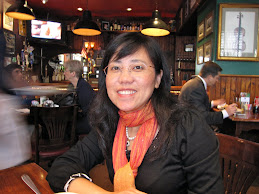
The past several weeks have been very busy as I made a brief return trip to the U.S. and then brought my wife back to China with me for a ten-day visit.
On Sunday April 13 I participated in an Environmental Regulation Roundtable held at the School of Public Policy and Management at Tsinghua University. Professor Qi Ye from Tsinghua served as host for the meeting. Outgoing EPA General Counsel Roger Martella, Jr. gave a presentation on “Federalism, Permitting & Public Participation: Three Pillars of U.S. Environmental Law.” Wang Jinnan from the Chinese Academy for Environmental Planning discussed “China’s Environmental Governance Reform.” He described the government reorganization that recently transformed China’s State Environmental Protection Agency (SEPA) into the new Ministry of Environmental Protection (MEP). Xiaobo Lu, a professor of political science from Columbia University who is visiting at Tsinghua, expressed considerable skepticism about the reorganization. Noting that it was referred to as a “platform for further reform,” he argued that for now it is largely just a change of name. The new MEP is still trying to figure out its functions, personnel, and other issues without any underlying law that clearly answers these questions.
I served as the discussant for a presentation by EPA attorney Steve Wolfson on “Permitting and Trading in U.S. Environmental Law.” I argued that environmental law had followed a similar evolution in both China and the U.S., beginning with ad hoc efforts to relocate polluting industries away from populated areas to end-of-the-pipe pollution controls and then efforts to encourage the development of better technology and process changes to reduce the generation of pollution. I noted that environmental policy needed to be more integrated into energy, land use, tax, transportation, and housing policies that substantially affect environmental conditions, something that the Chinese government could do given its greater emphasis on planning.
Zhang Jianming from the South China Center for Environmental Supervision discussed his organization’s work as one of the first two pilot “regional centers” set up by SEPA. While SEPA subsequently expanded these centers to eight, their status remains somewhat unclear as they are not really regional offices, but organizations to which SEPA assigns matters on an ad hoc basis. Unfortunately I had to miss Wang Canfa’s presentation in the afternoon that discussed this issue in more detail because I had to accompany my wife to the airport for her return flight to the U.S. The general impression I received is that the MEP is moving to elevate these centers to the status of regional offices.
This week the Chinese government announced details of their plans to clean up the environment prior to the Olympics by temporarily shutting down construction activities that generate fugitive emissions and requiring other sources of air pollution to make substantial cutbacks. The Boao Forum for Asia featured an address by Rajendra Pachauri, chair of the Intergovernmental Panel on Climate Change, who indicated that India will reveal its plans for addressing climate change this summer. While the China Daily hailed this as “India to Follow China’s Green Lead,” a Time magazine columnist deemed it far more significant that Chinese President Hu Jintao barely mentioned climate change in his address to the Boao Forum (see http://time-blog.com/china_blog/2008/04/president_hu_does_chinas_davos.html).
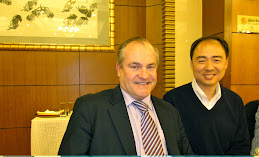
On Saturday night my wife and I had dinner with a young Chinese “news assistant” for a major U.S. newspaper. He has been involved in researching some important stories concerning environmental conditions in China. What was particularly interesting is that he reported that he is being berated by friends for working for the Western press, which is viewed by many Chinese as biased against China in light of its reports concerning the unrest in Tibet.
Wednesday, April 16, 2008

Wednesday, March 26, 2008
Maryland Trip Ends in Shanghai
On Sunday I said farewell to the group of 47 Maryland law students, alumni, faculty, and friends who spent their spring break visiting China. The trip was a huge success with the group visiting Beijing, X’ian and Shanghai. I did not accompany the group to X’ian on Wednesday because I had to teach class on Thursday and present a guest lecture at Tsinghua University’s School of Public Policy and Management. I flew to Shanghai on Friday morning to rejoin the group after they arrived from X’ian.
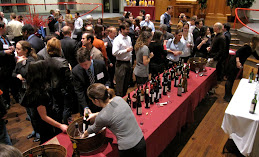
On Friday evening the group attended a reception at the Maryland Center, the state’s office that promotes trade and economic development with China. The reception was sponsored in part by DLA Piper, the firm that also had hosted a reception for us in Beijing. Several prominent members of the legal community in Shanghai were present at the reception. ZeeZee Zhong, director of the Shanghai branch of Jane Goodall’s Roots & Shoots organization gave a great presentation on their work promoting environmental education in primary and secondary schools in China. Peking University law professor Dan Guttman gave a wonderful talk debunking common misconceptions about the development of the rule of law in China. Ning Shao, Chief Representative of Maryland’s China Office, talked about the office’s work in promoting closer ties between Maryland and China.
On Saturday the group toured Shanghai, visiting the JinMao Building, the YuYuan Gardens, the Jade Buddhist Temple, and other notable sights. After a great farewell dinner on Saturday night, many of the students gathered at Shanghai nightspot the Glamour Bar on the Bund to party late into the night. On Sunday the group flew back to the U.S. and I returned to Beijing for another week of classes.
Wednesday, March 19, 2008
Maryland Environmental Law Students (& MLB) Arrive in China
On Friday March 14 a group of 47 Maryland law students, faculty, alums and friends arrived in Beijing to spend their spring break traveling around China. I met the group at the airport along with our China tour guide Zhong Xin and my student assistant Huang Jing. We have been having a terrific time. On Friday we visited Tiananmen Square and the Forbidden City. The group then went off to the Summer Palace while one of the students and I watched the debut of Major League Baseball in China with the Padres playing the Dodgers in an exhibition game at Wukesong Stadium, where the Olympic baseball competition will be held in August. We rejoined the group for a Beijing duck dinner. On Saturday night I led a group of students on an expedition to the watering holes of Houhai Lake. On Sunday we went to the Great Wall and then returned to Beijing for a tour of a hutong and dinner in a courtyard house.
A group of my Chinese environmental law students joined the Maryland group for some of their tours. On Monday the Maryland students came to the China University of Political Science and Law, where I teach, for a special program. The Maryland students showed some of the films they made in my environmental law classes over the years. They discussed with my Chinese students how to do it since I am asking the Chinese students to make films as a class project this semester. We also held a demonstration moot court, using members of Maryland’s International Environmental Moot Court Competition, who were questioned by some of my Chinese law students serving as judges. On Tuesday afternoon, we put on a program at the U.S. Embassy where both Maryland and Chinese students heard from lawyers working with environmental NGOs. These included Alex Wang, director of NRDC’s Beijing office, Zhang Jingjing, litigation director of the Center for Legal Assistance to Pollution Victims, and David Lennett, an environmental consultant who works with a number of NGOs in China. Two U.S. law firms hosted receptions for the Maryland students at their Beijing offices - Hogan & Hartson on Monday and DLA Piper on Tuesday.
I have posted online a web gallery of photos from the trip, which is at: http://gallery.mac.com/rperci/100148. I also have posted a gallery of photos of Major League Baseball in China at: http://gallery.mac.com/rperci/100141.
Tuesday, March 4, 2008
First Classes
This week I had my first classes at the China University of Political Science and Law (CUPL). CUPL probably has more students interested in Environmental Law than any other law school in China. This is in large measure the result of Professor Wang Canfa teaching there. He is the founder and director of the Center for Legal Assistance to Pollution Victims (CLAPV). I am teaching two classes at CUPL - Environmental Law, which meets for three hours on Monday afternoons, and Comparative Law, which meets for two hours on Thursday mornings. I am focusing on comparative environmental law in the latter class and using it to introduce the students to the concept of global environmental law.
There are 45 students in my Environmental Law class and 25 students in my Comparative Law class. As I do in my classes at Maryland, I start the first class by filming the students introducing themselves. I use the video to make individual photos of each students. This allows me use iPhoto to construct a digital seating chart, with the audio available to ensure that I can pronounce each name correctly. I then create a slideshow of the class to test myself on how well I remember each student’s names. I show the slideshow to the students at the beginning of the second last.
This practice has proven particularly valuable here in China where the names are somewhat harder for me to remember given my relative lack of familiarity with Chinese names and the fact that there are six Wangs in my Environmental Law class. It also elicited a particularly warm response from the Chinese students who frequently have classes where they sit passively as the professor lectures at them without making much effort to engage them. I posted the raw videos of the students online so that the students could view them. The Environmental Law class video is online at: http://gallery.mac.com/rperci#100102. The video of my Comparative Law class is online at: http://gallery.mac.com/rperci#100110.
I was impressed with the quality of the English spoken by many of my students, though I am following the advice of former Fulbrighters in trying to speak as slowly as possible. I also was impressed with the high level of interest in environmental law expressed by students in both classes. Class discussions of environmental issues leave me with the impression that there is less understanding of the threat of global warming here than among my Maryland students, perhaps because basic pollution problems pose a much more immediate challenge in China. There also seems to be much greater concern among my Chinese students about job prospects in the environmental field. While my Maryland students generally can be confident about their job prospects in the environmental field, many of the Chinese students are making a leap of faith that jobs will materialize in the future in a field that is just developing.
Tuesday, February 26, 2008
Fulbright Orientation
This week I attended a three-day orientation program for new Fulbright scholars in China, sponsored by the State Department’s Fulbright Program. Since there is no Fulbright Commission in China, the orientation was run by the U.S. Embassy. The program, which was held at the Swissotel in Beijing, brought together past and present Fulbright scholars who provided wide-ranging advice on living and teaching in China. It included briefings from political and medical officers from the embassy, a reception at the home of Daniel Piccuta, deputy chief of the U.S. Mission, lunch with Chinese Fulbright alumni, a visit to a Confucian temple, and dinner and dancing at the Makayame Tibetan Restaurant. It was a great opportunity to get to know the other Fulbrighters in China, many of whom I had met at the Washington, D.C. orientation last June. It also was fun to talk international politics with embassy personnel. Photos from the orientation can be viewed online at: http://gallery.mac.com/rperci/100084 A short video clip of dancing at the Tibetan restaurant is online at: http://gallery.mac.com/rperci/100094.
Beijing is considered a “hardship” post by the State Department in part because of the severity of the air pollution. Fortunately both traffic and pollution in Beijing have been lighter than normal in the past week. Embassy staff attributed this in part to the fact that many people were still taking Spring Festival vacations that had been delayed by the severe weather that hit China weeks ago. One diplomat noted that the fact that traffic and pollution levels could be noticeably affected by vacations illustrated how much motor vehicle ownership had penetrated into the Chinese middle class.
While at the Swissotel I ran into three former co-workers from my days at the Environmental Defense Fund (EDF) during the 1980s - Linda Greer and Susan Egan-Keane, who are now scientists at the Natural Resources Defense Council (NRDC), and David Lennett, a former EDF lawyer who is now a consultant for NRDC. They were meeting with staff from the Center for Legal Assistance to Pollution Victims (CLAPV), the Chinese public interest environmental group run by Wang Canfa, a professor at the China University of Political Science and Law where I am teaching this semester. I attended part of their meeting to launch the joint China-NRDC Public Health and Law Project on Friday. The project initially will focus on using NRDC’s legal and scientific expertise to assist CLAPV in seeking redress for villagers harmed by pollution from mining waste.
In talking to embassy staff, I learned that Major League Baseball will soon be making its debut in China. On March 15-16, the Los Angeles Dodgers will play two spring training exhibition games in Beijing against the San Diego Padres at Wukesong Stadium, where the Olympic baseball competition will be held. One of the owners of the Dodgers, Jamie McCourt, who is an alum of the University of Maryland School of Law, will be accompanying the team. My dean is trying to arrange tickets through her because the dean and a group of other Maryland faculty and students will be visiting me in China then during Maryland’s spring break.
Sunday, February 17, 2008
Arrival in China
I arrived in China on Friday to start my semester teaching as a J. William Fulbright Distinguished Lecturer at the China University of Political Science and Law. Chinese universities start their spring semester after the Spring Festival and celebration of Chinese New Year, which is why classes don’t start until February 25. The spring semester runs until early July.
The nonstop flight from Washington Dulles to Beijing flies north-northeast, passing over western Greenland and then just east of the North Pole. Greenland was a frequent topic in my household growing up, long before thoughts of it centered on the possibility that global warming may melt its icecap, because my father had been stationed in Greenland during World War II. He described it as a cold and boring experience. The only “combat” he saw was a mission to destroy a German weather station on the east side of the island, which turned out to be unoccupied. I inherited the incredible Army parka my father used in Greenland, which I wore frequently during the Minnesota winters while in college. It saved me from serious injury when I was in a van that rolled over, killing the driver, who was my best friend and debate partner, on the way to a debate tournament.
The flight to Beijing, which takes more than 13 hours from Washington, passed over the North Pole in darkness. Nine hours after takeoff the sun rose as the flight entered Russian airspace over northern Siberia. While this was my ninth flight to China in the last three years, it was the first time the flight flew over Lake Baikal, the largest freshwater lake in the world by volume. The lake is located just north of the Mongolian border and east of Irkutsk (a place familiar to players of the game “Risk”). The lake has been the subject of environmental controversy concerning the siting of a paper mill along its shores. Our flight flew just east of Irkutsk, providing an excellent view of the ice and snow-covered lake and what most likely was the Russian town of Babushkin on the southeastern shore.
Just minutes before the flight landed in Beijing, it passed over a portion of the Great Wall of China just north of Beijing. A common myth is that the Great Wall is the only man-made structure visible from outer space. In fact it is one of many manmade objects that can be seen from space and it is far from being the most visible one (see http://www.space.com/scienceastronomy/visible_from_space_031006.html).
On my flight was Jun Bi, deputy dean of the School of Environment at Nanjing University. I first met him in March 2005 when I gave a guest lecture in Nanjing. In July 2005 I had the privilege of introducing his family to American baseball by taking them to a Washington Nationals game at RFK Stadium. Prior to boarding the plane, Jun Bi wisely stopped at Vino Volo near the departure gate at Dulles to purchase wine to bring to China where wines are much more expensive than in the U.S. Also on the flight I met Susan Beth Farmer, a law professor from Penn State-Dickinson School of Law, who will be teaching this spring as a Fulbright scholar at the University of International Business and Economics in Beijing. The U.S. Embassy in Beijing sent two representatives to meet us at the airport. They were nice enough to drive Beth to the hotel where the Fulbright orientation will be held and me to my apartment in downtown Beijing. My apartment is in The Towers above Oriental Plaza, three blocks east of Tiananmen Square and the Forbidden City in the heart of downtown. It is above the best shopping mall in the city and the Wangfujin subway stop, and an easy walk to the Gui Jie “snack street”.
I love my new apartment and I am thrilled to be living in China.
Monday, February 11, 2008
China Move, Casebook Update & Chile Conference
This is the last time for several months that I will be making a post from the United States. I am moving to China on Thursday to begin my semester teaching as a Fulbright scholar at the China University of Political Science and Law. I expect that many of my future postings will deal with my experiences in China, like the blog Tseming Yang maintained when teaching as a Fulbright scholar at Tsinghua Unversity during the fall semester 2005.
Tseming and I met briefly in Baltimore on Friday to discuss the progress of our Global Environmental Law casebook project. We had a lengthy conference call with the editor Aspen Publishing has assigned to us. I am delighted to have an editor who I have previously worked well with on various projects.
Valentina Duran from the University of Chile’s Center for Environmental Law was kind enough to send me a photo displayed of her wearing a Maryland Law softball cap at Laguna Biscanti near San Pedro de Atacama in northern Chile. She proposes that we try to collect photos of the hat in as many far flung locations as possible. Valentina’s Center will be hosting a conference on “Sustainable Development: Governance and Law” from June 25-27, 2008. My proposal to prepare a paper on “The Emergence of Global Environmental Law” for the conference has been approved. While I am not certain whether I will be able to attend the conference in person (it’s a very long way from Beijing), I will submit a Spanish translation of the paper for the publication that the Center will be distributing at the conference.
Subscribe to:
Posts (Atom)