Ma Jun Receives Prince Claus Award

Ma Jun Receives Prince Claus Award
Chinese environmentalist Ma Jun receives the Prince Claus Award at the Dutch Royal Palace in Amsterdam on Dec. 6, 2017

March 2013 Environmental Field Trip to Israel

March 2013 Environmental Field Trip to Israel
Maryland students vist Israel's first solar power plant in the Negev desert as part of a spring break field trip to study environmental issues in the Middle East

Workshop with All China Environment Federation

Workshop with All China Environment Federation
Participants in March 12 Workshop with All China Environment Federation in Beijing

Winners of Jordanian National Moot Court Competition

Winners of Jordanian National Moot Court Competition
Jordanian Justice Minister Aymen Odah presents trophy to Noura Saleh & Niveen Abdel Rahman from Al Al Bait University along with US AID Mission Director Jay Knott & ABA's Maha Shomali

Monday, July 15, 2013

Return from New Zealand, Environmental Issues Down Under (by Bob Percival)

My wife Barbara and I arrived home from our New Zealand vacation at 3:20AM this morning.  I flew on United from Auckland via Sydney, while Barbara had a more circuitous route on Singapore Air through Singapore and Seoul as part of a ticket purchased with airline miles.  We met up at the San Francisco Airport and I agreed to let her have my first class seat on the flight from San Francisco to Dulles, which was delayed for nearly two hours.  Barbara ended up sitting on the plane next to Nancy Pelosi, former Speaker and now Minority Leader of the U.S. House of Representatives.  Barbara’s late grandfather had briefly been a fellow member of the Maryland delegation in Congress with Pelosi’s father Thomas D’Alesandro, Jr. who later became mayor of Baltimore.

We had the best vacation ever exploring New Zealand for two weeks after the end of the IUCN Academy of Environmental Law Colloquium at Waikato University.  We started in the north on Waiheke Island near Auckland and drove south as far as Christchurch on the South Island.  We went winetasting at vineyards in six different wine regions of New Zealand and had some really memorable meals.  As mentioned last week, we hiked part of the Queen Charlotte Track with ferries depositing us on one part and picking us up on another.  Last Tuesday we spent an afternoon whale watching off the east coast of the South Island near Kaikura.  We saw three sperm whales and visited a sea lion colony.  On Thursday we took one of the most spectacular train rides in the world - the TraNZalpine railway from Christchurch to Greymouth.  It crosses New Zealand’s beautiful Southern Alps from the east coast to the west coast of the South Island in the morning and then returns in the afternoon.  

Before flying back to Auckland on Friday we toured the International Antarctic Center across the street from the offices of the U.S. Antarctica Program adjoining the Christchurch Airport.  This is the supply center for the U.S. bases in Antarctica.  The museum is fascinating with some terrific films of Antarctica and visitors can take a ride on a Hagglund vehicle widely used for exploration on the ice.  

Traveling in New Zealand and spending a day in Sydney on my return, I was  struck by the variety of environmental issues that are being debated by the public.  The town of Dunedin on the South Island is struggling to enforce ordinances designed to reduce smoke pollution by requiring homeowners to replace wood stoves with cleaner burning units.  Despite offering subsidies to finance the switch there has been widespread noncompliance so government officials are threatening to levy heavy fines.  In Australia the big environmental news was new Prime Minister Kevin Rudd’s announcement that the government would scrap the politically controversial carbon tax and replace it with a cap-and-trade program to be phased in a year earlier than previously contemplated.   Rudd promptly was accused by the conservative opposition (oddly called the Liberal Party) of being a flip-flopper.  Yet most of the public seems to take climate change seriously in light of the record heat during the summer and the debate has centered on the best approach to reduce greenhouse gas emissions.  

Australian environmental groups split over a plan to protect forests in Tasmania with some groups arguing that the plan does not go far enough to preserve forests.  Hydraulic fracturing also is becoming a big issue in Australia.  Since the government in Australia generally owns the subsurface resources under private property, the political dynamics of the fracking issue may be altered in ways that could foster some interesting comparative studies.  A common theme running through many of the environmental debates down under is that individuals offer more resistance to environmental measures that visibly cost them, such as a carbon tax or the need to scrap old wood stoves, and they are less enthusiastic about fracking when most of the benefits will go to the government while most of the burdens are put on their surface landholdings.

This was my first trip to New Zealand, the 82nd country I have visited.  I would love to return during New Zealand’s summer and visit the southern part of the South Island, including Milford Sound, when the weather is better. I took some great photos on the trip that I will be posting in the photo section of my parallel website at http://www.globalenvironmentallaw.com in the next few days.

Sunday, July 7, 2013

ICJ Hears Australian Case Against Japan Whaling, Tonga's Lifuka Debates Sea Level Rise, New Zealand's Maui's Dolphin (by Bob Percival)


I am in New Zealand for another week, now traveling on the South Island.  There has been considerable publicity here concerning the hearings at the International Court of Justice (ICJ) in the Hague on Australia’s case (Whaling in the Antarctic (Australia v. Japan: New Zealand intervening)) against Japan for whaling in the Antarctic in alleged violation of the International Whaling Commission’s moratorium on commercial whaling.  Australia launched the proceedings in May 2010 and New Zealand intervened in the case in February 2013 to support Australia’s claim that Japan’s whaling is illegal.  Japan claims that its whaling is legal under the exception for scientific research.  It also argues that Australia is trying to impose its own cultural values on Japan and that Australia and New Zealand have no basis for complaining about what Japan does outside of their territorial waters. Japan has taken more than 10,000 whales in the southern hemipshere under the guise of scientific research.  It currently allows 935 minke whales, 50 fin whales and 50 humpbacks to be taken, though only 18 fin whales and no humpbacks have been taken yet.  

New Zealand media are reporting that Pacific leaders will be meeting tomorrow to discuss how to cope with rising sea levels and subsiding land in the Tongan island of Lifuka.  More than 7,000 people live on Lifuka, which has lost many homes to rising sea levels and land sinking due to an earthquake fault.  Leaders are debating whether to build an expensive sea wall to try to prevent further flooding in the future or to relocate the residents.  Last week I was in Napier, New Zealand, where a February 1931 earthquake suddenly thrust land that had been under Hawke’s Bay two meters upward, creating dry land on which Napier’s airport was built.  I also toured the Parliament building in Wellington, that has been “seismically isolated” by being sliced from its foundation and placed on special load bearing ball bearings that allow the entire building to move back and forth in the event of an earthquake.  

While in Wellington I spent a morning hiking in Zealandia, a nature preserve in the hills above the city.  The preserve represents an ambitious effort to restore 225 hectares of land to its natural state as part of a 500-year plan.  Many rare species of birds have been attracted to the sanctuary.  Since the reserve is built directly over an earthquake fault, one wonders whether anyone can confidently predict what it will look like in 500 years.  Te Papa, the outstanding national museum of New Zealand located on Wellington’s waterfront, has several outstanding exhibitions on New Zealand’s fascinating ecological history and the severe harm invasive plant and animal species have caused to native flora and fauna.

Yesterday I traveled by ferry from Wellington on New Zealand’s North Island across the Cook Strait to Picton on New Zealand’s South Island.  After the ferry entered Queen Charlotte Sound we observed a group of dolphins welcoming us.  Today while taking a ferry from Picton to Ship Cove, the start of the Queen Charlotte Track, on which we hiked, we also observed dolphins in the Sound.  These were not the endangered Maui’s dolphin, of which it is estimated there are only 55 remaining who are more than one-year old.  They are located on the west coast of the North Island.  Last September New Zealand was the only nation to vote against a resolution at the IUCN’s World Conservation Congress in Korea calling for expanded protection of the Maui’s dolphin.  On July 6, New Zealand’s Dominion Post newspaper revealed that New Zealand’s lone vote in opposition to the resolution was dict'ated by New Zealand’s Ministry for Primary Industries over the opposition of the country’s Department of Conservation (DOC).  New Zealand’s DOC had urged that the government at least abstain rather than opposing the resolution, according to documents obtaining by the newspaper.  Matt Stewart, “Lack of Evidence” Behind NZ Vote Against Maui’s Aid, The Dominion Post, July 6, 2013, at A14.

Sunday, June 30, 2013

IUCN Academy Colloquium, Obama Climate Plan, Supreme Court Decides Takings Case & Agrees to Review Interstate Air Rule (by Bob Percival)

I am currently in New Zealand where I participated in the 11th Colloquium of the IUCN Academy of Environmental Law from June 24-28.  With me at the Colloquium were five of the Maryland law students from my Global Environmental Law seminar who presented papers at the Colloquium, Global Environmental Justice Fellow Gabby Queenan from Macalester College, and Bill Piermattei, managing director of Maryland’s Environmental Law Program.  Monday June 24 featured an all day workshop on the teaching of environmental law.  I gave a presentation on how a massive open online course operates and a demonstration of the SmartBook technology that enables me to include customized, multimedia materials in the electronic version of my casebook.  Tuesday June 25 featured an all day research workshop.  Plenary sessions were held on Wednesday and Thursday morning and a forum featuring some of the world’s top environmental judges was held on Friday morning.  Combined with breakout sessions on Wednesday, Thursday, and Friday, more than 160 presentations were made on a fascinating array of environmental topics.  The full program is available online at: http://iucnacademy2013.org.nz 

The Academy of Environmental Law now includes 168 institutional members from 53 countries.  More than 200 people attended the Colloquium from at least 30 countries.  Despite the upbeat atmosphere from seeing so many old friends at the Colloquium, speaker after speaker shared depressing news concerning the state of the world’s environment and efforts to roll back environmental protection in several countries.  Considerable discussion focused on why decades of effort to strengthen environmental law has not yielded more positive environmental results. This year’s distinguished scholar lecture was presented by Mas Achmad Santosa, Deputy Minister and Deputy Head of the President’s Delivery Unit for Development Monitoring & Oversight of the Republic of Indonesia.  He gave a remarkably candid presentation concerning how Indonesia is trying to locate and suppress the sources of massive fires in Sumatran palm oil plantations that have blanketed Singapore and Malaysia with record air pollution.

Most of the participants in the Colloquium welcomed President Obama’s announcement on Tuesday June 25 of his Climate Action Plan (http://www.whitehouse.gov/sites/default/files/image/president27sclimateactionplan.pdf) as a useful step for responding to this enormous global challenge.  In his plan President Obama recommitted his administration to the goal of reducing U.S. greenhouse gas (GHG) emissions by 17 percent below 2005 levels by the year 2020.  In a memorandum to EPA issued the same day, available online at: http://www.whitehouse.gov/the-press-office/2013/06/25/presidential-memorandum-power-sector-carbon-pollution-standards, the President directed EPA to propose GHG emissions standards for existing power plants by no later than June 1, 2014, and to adopt them in final form by June 1, 2015.  Among the many elements of the President’s plan are measures to speed permitting of renewable energy projects, to increase energy efficiency standards for appliances and federal buildings, and to develop an interagency strategy to reduce methane emissions.  The President also pledges that the U.S. will play a more vigorous global leadership role on climate change issues. 

While I was at the Colloquium, the U.S. Supreme Court finished its October 2012 Term.  On Monday June 24 the Court announced that it will hear challenges to the D.C. Circuit’s decision striking down EPA’s interstate air pollution rule (see August 26, 2012 blog post).  The Supreme Court’s decision to review this case is a most welcome development because the D.C. Circuit’s decision (EPA v. EME Homer City Generation, 696 F.3d 7) featured extraordinary judicial activism to ensure that no state had to do too much to control interstate air pollution.  The case will be argued and decided during the Court’s next term that starts in October 2013.  

On June 25 the Court decided an important regulatory takings case.  In Koontz v. St. Johns River Water Management District the Court extended its Nollan/Dolan regulatory exactions doctrine to decisions to deny a permit to develop wetlands and to regulatory exactions that involve a payment of money rather than a dedication of real property.  The decision was 5-4 with the Court’s four liberals dissenting.  The dissenters agreed that permit denials could be subject to Nollan/Dolan review, but disagreed that exactions involving the payment of money should be subjected to such review.  Writing for the majority, Justice Alito emphasized that the Court’s decision did not call into question the constitutionality of property taxes. He downplayed the impact of the decision by noting that many states, such as California, already apply the Nollan/Dolan “rough proportionality” requirement to impact fees exacted when developers seek variances. 

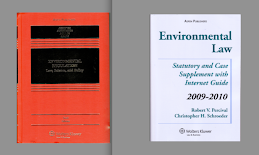
Koontz was decided just as I was making the final corrections to the second pass page proofs for the new 7th edition of my casebook Environmental Regulation: Law, Science and Policy.  My publisher allowed me to include a new paragraph discussing the decision in the book, which will be in bookstores next month in time for fall semester 2013 classes.

Saturday, June 22, 2013

China Cap-and-Trade Pilot, Australian Campaign, Sumatra Fires Pollute Singapore, Lacey Act Restitution, EU & Canada Transparency Initiatives, IUCN Colloquium (by Bob Percival)

On June 18 China launched its first cap-and-trade pilot program for carbon emissions in the city of Shenzen.  In the first trade China’s largest oil company PetroChina purchased 10,000 carbon allowances from Shenzen Energy Group, an electric utility, at a price of only $4.90 per metric ton. The cap-and-trade program will be expanded to seven locations in China by the end of 2014, including the cities of Beijing, Shanghai, Tianjin, and Chongqing and the provinces of Guangdong and Hubei, before being launched nationwide in 2015.  Shanghai is expected to launch its program next month.

Australia’s carbon tax and emissions trading scheme have become major issues in the current electoral campaign there.  Opposition leader Tony Abbott acquired his leadership position by reversing his previous support for emissions trading, which he argued would hurt Australia industries who compete with China.  Now that China is adopting cap-and-trade, Abbot argues that Australia’s program should be abolished in favor of unspecified “direct action” to control emissions.  Abbott’s opposition coalition notes that China’s carbon price is only about $5 per ton compared to Australia’s $23/ton carbon tax.  Supporters of Australia’s program note that 94.5% of carbon emissions permits are being distributed free of charge to emissions-intensive, trade-exposed industries, making the effective price of the carbon tax much less than China’s.  Despite the opposition’s attack on the carbon tax, there remains bipartisan support for measures to reduce Australia’s carbon emissions by 5% below 2000 levels by 2020. Craig Emerson, Not Pretty Under Abbott’s Fig Leaf, The Australian, June 22-23, 2013, at 20.

Forest fires raging in Sumatra have caused record levels of air pollution in SIngapore.  On the night of June 19 Singapore’s air Pollution Standards Index registered 321, an all-time record.  The following day the index registered another new record of 371.  Anything about 200 is considered hazardous to health.  Andrew Tan, the chief executive of Singapore’s National Environmental Agency, traveled to Jakarta to demand “definitive” action by the Indonesian government to control the pollution.  Singapore authorities have urged residents to avoid outdoor activities.  The Indonesian forestry ministry reportedly is using helicopters to seed the clouds in hope of producing rain to combat the fires. “Indonesia Urged to Clear the Air with Neighbours,” Sydney Morning Herald, June 21, 2013, at 17.  

On June 14 a federal district judge in New York ordered three defendants who illegally harvested rock lobsters in South Africa and imported them into the U.S. to pay $29.5 million in restitution to the government of South Africa.  The restitution ordered is the largest ever under the Lacey Act, a federal law that prohibits the importation of fish, wildlife or plants taken in violation of the laws of another country.  The three reportedly bribed South African fisheries inspectors and submitted false export documents.  Ben DiPietro, Record Restitution Order for Lacey Act Violations, Wall Street Journal, June 17, 2013.

Last week Publish What You Pay, a coalition of civil society organizations in Nigeria, urged the Nigerian government to require disclosure of payments made by extractive industries to government officials.  Bassey Udo, Nigeria: Emulate European Nations, Canada on Extractive Industries Transparency, Group Tells Nigeria, Premium Times, June 17, 2013.  On June 12 the European Parliament voted to require “EU-listed and large privately owned oil, gas, mining and logging companies to publish – country by country and project by project – all payments over €100,000 to governments wherever they operate. This follows agreement between the European Parliament, Member States and Commission after months of negotiations, and brings the EU finally into line with similar extractive industry transparency rules that take effect this year in the U.S. under the 2010 Dodd-Frank Act.” The government of Canada also announced that it will adopt similar transparency rules for its exrtractive industries.  Publish What You Pay Applauds Historic EU Parliament Transparency Vote as Canada Announces Similar Plans, June 12, 2013.

On Tuesday night I flew from San Francisco to Sydney, Australia en route to New Zealand for the annual Colloquium of the IUCN Academy of Environmental Law. I arrived in Sydney early on Thursday morning.  This year the Academy Colloquium, which Maryland hosted last summer, is being held at the University of Waikato in Hamilton, New Zealand, approximately 75 miles south of Auckland. It will run from June 24-28.  Five law students from Maryland will be presenting papers at the Colloquium along with myself and Program Managing Director Bill Piermattei.

Sunday, June 16, 2013

Chinese Air Pollution Regulations, Ghana Crackdown on Wildcat Mining, Myanmar, Ethiopian Dam (by Bob Percival)


On June 14 China’s State Council adopted new air pollution control regulations.  One of the surprising features of the 10-part regulations is a requirement that large polluters disclose to the public information about their emissions. The regulations mandate that large sources reduce their emissions per unit of production by 30% by the year 2017. The regulations require the use of significantly cleaner fuels in motor vehicles, a requirement already in place in Beijing and Shanghai.  The regulations strengthen penalies for failure to comply with environmental regulations.  They also mandate that municipal governments assess the risks of protests derailing their development plans.  Keith Bradsher, N.Y. TImes, June 16, 2013, at A11.

The government of Ghana has conducted a harsh crackdown during the last two weeks on heavily polluting wildcat gold mines operated primarily by prospectors from China.  At least 169 Chinese have been arrested for operating illegal gold mines and many others are in hiding. Many of the miners were from Guangxi, China and the Chinese government reportedly has agreed to post bail, pay fines and facilitate their return to China.  Adam Nossiter & Yiting Sun, Chasing a Golden Dream, Chinese Miners Are on the Run in Ghana, N.Y. Times, June 11, 2013, at A4.

As Myanmar opens up to the outside world, environmental activists there are becoming more influential.  Ko Lay Lwin, a former airline accountant, has become a leading environmental opponent of a proposed multi-billion dollar deepwater port and coal-fired power plant project at Dawei.  The project, to be built by Italian-Thai Development PCL, has been stalled in part due to environmental opposition.  As Thai environmentalists have gained increasing clout, more Thai companies are exploring development projects in Myanmar.  Thai environmentalists increasingly are assisting their counterparts in Myanmar, who felt empowered after the Myanmar government stopped China’s giant Myitsone dam project on the Irrawaddy River in late 2011.  Myanmar reportedly is considering joining the Extractive Industries Transparency Initiative. James Hookway, Asia’s Green Activists Spread Their Roots, Wall St. J., June 12, 2013, at A1.

On June 10 Egyptian President Mohammed Morsi harshly criticized the government of Ethiopia for its plans to build Africa’s largest hydroelectric dam on the river Nile. Morsi, who fears that the dam will greatly reduce the flow of the Nile into Egypt, declared that “all options are open” in opposing the dam.  While he did not specifically threaten war, he stated that if “a single drop of the Nile is lost, our blood is the alternative.”  On June 11 sources indicated that negotiations were underway between Egypt and Ethiopia over the $4 billion project.

Construction of the first new nuclear powerplants in the U.S. in 30 years is now nearly one-third complete, but at least 14 months behind schedule.  The Vogtle 3 and 4 nuclear reactors being built in Waynesboro, Georgia by the Southern Company are now expected to cost approximately $14 billion, far more than the $8.87 billion spent on Vogtle 1 & 2, which were completed in 1987 and 1989. Cost overruns and delays have been caused in part by problems with suppliers.  With the price of natural gas low it remains to be seen whether the project will prove to be economical in the long run.  Vogtle 3 is now scheduled to open in 2017, but some are anticipating further delays in the schedule. Matthew L. Wald, Atomic Power’s Green Light or Red Flag, June 12, 2013, at B1.

Monday, June 10, 2013

Global CO2 Use Up 1.4% in 2012, Obama and Li Agree to Reduce HFC Use, U.S. Offshore Wind Leasing (by Bob Percival)


In a report issued on June 9 the International Energy Agency (IEA) estimated that global emissions of carbon dioxide (C02) from energy use increased by 1.4% to 31.2 gigatons in 2012.  The report predicts that if emissions of greenhouse gases continue to increase at such a rate, global temperatures could increase by as much as 5.3 degrees Celsius (9 degrees Fahrenheit) over pre-industrial levels, which “would be a disaster for all countries.”  The one bright spot was the U.S. where increased production of natural gas from shale formations accounted for half of the 3.8% drop in U.S. CO2 emissions from energy use. China, however, more than offset the U.S. decrease because its emissions increased by 3.8% in 2012, even though China’s CO2 emissions per unit of electricity generated dropped by 17%.  Japan’s CO2 emissions from energy use rose by 5.8% due to the shutdown of nuclear power generation in the wake of the Fukushima Daiichi disaster. The IEA report, Redrawing the Energy-Climate Map, is available online at: http://www.worldenergyoutlook.org/media/weowebsite/2013/energyclimatemap/RedrawingEnergyClimateMap.pdf.  It argues that global greenhouse gas emissions can be controlled to prevent the most catastrophic effects of climate change if four existing policies are expanded: improving energy efficiency, limiting construction and use of coal-fired power plants, minimizing methane emissions from oil and gas production, and phasing out fossil fuel subsidies.

At a summit meeting held in California, President Barack Obama and Chinese President Xi Jinping agreed on June 8 to phase down production and consumption of hydrofluorocarbons (HFCs), a potent greenhouse gas. The two leaders agreed that China and the U.S. have “strong joint interests in addressing the climate issue,” according to outgoing U.S. national security adviser Tom Donilon. HFCs are among the greenhouse gases that also threaten the earth’s protective ozone layer.  Thus, efforts to phase them out are being undertaken pursuant to the Montreal Protocol on Substances that Deplete the Ozone Layer.

Last week the U.S. Department of Interior announced that on July 31 it will sell leases for wind energy projects on more than 164,000 acres of federal waters off the coast of Rhode Island.  It is estimated that the lease area is sufficiently large to accommodate 3,400 megawatts of new wind energy projects.  John M. Broder, U.S. to Lease Federal Waters for Commercial Offshore Wind Energy, N.Y. Times, June 5, 2013, at B5.  Note also NPR on Omaha Beach.

On June 4 a letter from Todd Foley of the American Council for Renewable Energy was published in the Wall Street Journal.  The letter responded to the Journal’s May 24 editorial attacking Tesla Motors, which produces all-electric automobiles, primarily the Tesla S, which I drive. The letter, “Electric Cars and U.S. Innovation,” Wall St. J., June 4, 2013, notes that “Tesla not only repaid its commitment to the U.S. government nine years early, but it also paid an additional $26 million in interest for the taxpayer.” Thus, it concluded that the answer to the Journal’s question concerning when the "rest of America" will get its return on Tesla's profits by declaring that it did “on May 22, 2013.” The letter notes that Tesla was founded “entirely via private financing”and “from 2003 to 2009, the company developed cutting-edge electric vehicles without seeing even a dime of taxpayer money.”  It observes that “the bipartisan DOE loan guarantee program has a 97% success rate.” Thus, it concludes that “when a company—in this case, Tesla—demonstrates fiscal responsibility, American innovation and a sense of duty to the taxpayer,” it should “be a cause for celebration, not condemnation.”

Last Wednesday my wife Barbara sang the national anthem prior to the Washington Nationals/New York Mets game at Nationals Park as a member of the Congressional Chorus singing group (http://www.youtube.com/watch?v=3nAJIes0FQs).  They were not good luck for the Nats who lost to the Mets by 10-1.  On Friday I flew to Minneapolis for my Macalester College Reunion.  Macalester has a terrific environmental studies program and one of its students, Gabrielle Queenan is working with me this summer on a Global Environmental Justice Fellowship.  On Sunday June 9 I flew back to D.C. from Minneapolis in time to see the Nats defeat the Minnesota Twins in the second game of a doubleheader necessitated by a rainout on June 7.

Sunday, June 2, 2013

Law & Society Meeting, Freedom Pipeline Canceled, Rogue GMO Wheat Discovered (by Bob Percival)

From Thursday through Sunday I was in Boston to attend the Annual Meeting of the Law and Society Association.  I chaired a panel on Natural Resources, Climate Change and Animal Rights on Friday.  On Saturday I spoke on a panel on “Commotion in China: Emerging Legal Issues for an Emerging Superpower.”  Also on the panel with me were Professors Margaret Woo (who spoke about China’s new civil procedure code), Cindy Estlund (who spoke about union elections in China), and Alex Wang (who spoke about transparency and access to information).  I spoke about the evolving role of civil society in influencing Chinese environmental policy.  Much of my talk focused on burgeoning public protests over environmental conditions and the siting of chemical plants.  One of the great aspects of Law and Society meetings is that professors from so many different disciplines share insights on important issues.  On the panel that I chaired there were speakers from a sociology department, a geography department, a political science department and an international relations department.  Climate change seemed to be the environmental issue that was getting the most attention from professors in these other disciplines.

I was really gratified to learn that my mentor, Stanford Law Professor Lawrence Friedman, was to receive the Law and Society Association’s annual Stanton Wheeler Mentorship Award.  While a law student at Stanford, I had the privilege of working with Lawrence as a research assistant.  We subsequently co-authored two articles and a book (The Roots of Justice: Crime and Punishment in Alameda County, California 1870-1910) that in 1982 won the Association’s J. Willard Hurst Award.  When I accepted the award at the Law and Society Annual Meeting in 1982, the membership of the Association then was almost entirely from the U.S.  Now its international membership has grown to the point where 35% of Law and Society members are from outside the U.S. mostly of these from Europe and Asia.

Writing the letter I wrote in support of Lawrence’s nomination for the Mentorship Award made me appreciate once again the immense influence he had on my career.  While speaking to a group of law clerks in D.C. a few months ago, one of them had asked me how my career would have been different if I had not been a law clerk for a Supreme Court Justice.  After thinking about it, I realized that not being a Supreme Court clerk probably would not have changed my career path significantly.  But were it not for Lawrence, who insisted that I should become a law professor, I probably would not have pursued what I consider the best job in the world.

On Friday Kinder Morgan Energy Partners LP announced that they had canceled plans for the proposed $2 billion Freedom pipeline to carry crude oil from Texas to California oil refineries.  California oil refineries refused to commit to buying oil transported by the proposed pipeline, preferring the greater flexibility of transporting oil by rail, which allows them to respond to pricing changes by diversifying their sources of supply. Valero Energy Corporation has invested $30 million in a project to build a rail terminal at its 170,000 barrel-a-day refinery in Benicia, California.  Other California refineries also are preparing to receive rail shipments of cheaper oil from the midwest.  Ben Lefebvre, Kinder Morgan Ends Pipeline Plan for West Coast, Wall St. J., June 1-2, 2013, at B3.

Last week a farmer in Oregon found an unapproved strain of genetically modified wheat growing like a weed in his field.  The discovery was made because the farmer sprayed the wheat with the herbicide Roundup and some of the wheat survived.  While authorities investigate, Japan has canceled a bid on 27,500 tons of U.S. wheat, South Korea also has suspended its bidding, and EU authorities called for increasing testing of U.S. imports.  In 2012 exports accounted for $8.1 billion of the $17.9 billion U.S. wheat crop. John Upton, Japan and Other Nations Say No to U.S. Wheat, Worried About GMOs, Grist, May 31, 2013.