Ma Jun Receives Prince Claus Award

Ma Jun Receives Prince Claus Award
Chinese environmentalist Ma Jun receives the Prince Claus Award at the Dutch Royal Palace in Amsterdam on Dec. 6, 2017

March 2013 Environmental Field Trip to Israel

March 2013 Environmental Field Trip to Israel
Maryland students vist Israel's first solar power plant in the Negev desert as part of a spring break field trip to study environmental issues in the Middle East

Workshop with All China Environment Federation

Workshop with All China Environment Federation
Participants in March 12 Workshop with All China Environment Federation in Beijing

Winners of Jordanian National Moot Court Competition

Winners of Jordanian National Moot Court Competition
Jordanian Justice Minister Aymen Odah presents trophy to Noura Saleh & Niveen Abdel Rahman from Al Al Bait University along with US AID Mission Director Jay Knott & ABA's Maha Shomali

Tuesday, July 31, 2018

Supreme Court Refuses to Halt Juliana Trial, NY City Climate Suit Dismissed, Zhang Jingjing in Court in Ecuador, IUCN Colloquium (by Bob Percival)

Yesterday, in what likely was his last act as a Justice of the Supreme Court, Anthony Kennedy joined his colleagues in refusing the Solicitor General’s request to stay discovery and the upcoming trial in the Juliana v. U.S. lawsuit by young people seeking to hold the federal government liable for failing to protect them against climate change.  In an unsigned order the Court called the government’s request for relief “premature.” However, like the 9th Circuit noted when it denied a similar motion, the Supreme Court cautioned that the “breadth of respondents’ claims is striking,”and it opined that “the justiciability of those claims presents substantial grounds for difference of opinion.” The Court’s order cautioned the federal district court hearing the case in Portland, Oregon to “take these concerns into account in assessing the burdens of discovery and trial, as well as the desirability of a prompt ruling on the Government’s pending dispositive motions.”  Justice Kennedy’s resignation becomes effective today, leaving the Court with eight members until the Senate confirms a new Justice. 
On July 19 federal district judge John F. Keenan dismissed the city of New York’s common law nuisance suit against Chevron, Conoco Phillips, ExxonMobil and Royal Dutch Shell for fossil fuel production that contributes to climate change.  Citing the Supreme Court’s 2011 decision in American Electric Power v. Connecticut (AEP), the judge held that the Clean Air Act displaces the federal common law of nuisance because it gives EPA responsibility to regulate emissions of greenhouse gases.  Responding to the city’s state law nuisance claim, Judge Keenan distinguished the case from AEP, which refused to decided whether the Clean Air Act displaces state law nuisance claims.  Because New York City’s case involved the use of fossil fuels sold worldwide, rather than emissions from specific power plants as in AEP, the judge held that state nuisance law could not be used because a single federal standard should apply.  Several other cities and states have brought climate suits against oil companies with mixed results.

On July 23 Zhang Jingjing, who this week is joining Maryland Law’s Transnational Environmental Accountability (TEA) Project, appeared in court in Cuenca, Ecuador to support indigenous tribes seeking to have an appellate court uphold a lower court’s revocation of a mining permit awarded to a Chinese company. Jingjing’s amicus brieft was written in three languages - Chinese, English and Spanish.  She argued that issuance of the permit without any notice or consultation with affected indigenous populations violated norms under both Chinese law and international law.  The court will issue its decision shortly.  More details on this case are available at: https://intercontinentalcry.org/can-the-law-prevail-over-chinese-investments-in-ecuador/ The TEA Project is focusing on holding multinational companies accountable for environmental harm they cause in developing countries.

Earlier this month two of my colleagues and I, joined by three Maryland students and recent graduates, made presentations at the 16th Annual Colloquium of the IUCN Academy of Environmental Law in Glasgow, Scotland. This year 400 participants from nearly 40 countries attended the Colloquium, a new record for the Academy. The theme of the colloquium, which was held at the University of Strathclyde from July 3-6, was “The Transformation of Environmental Law and Governance: Innovation, Risk and Resilience.”

Joined by rising 3L Alex Belman, I presented a history of innovation in environmental law and policy on July 5. The presentation traced the evolution of innovations such as protected areas, freedom of information, environmental impact assessment, emissions trading, and pollution disclosure requirements. I also gave a presentation on the challenges of teaching environmental law at a special pre-colloquium Teaching and Capacity-Building Workshop on July 3.

Maryland’s environmental law partnership with Pace University currently serves as the secretariat for the IUCN Academy,which was founded in 2003. Pace hosted the Academy’s fourth colloquium in 2006 and Maryland hosted the tenth colloquium in 2012. Next year’s colloquium will be held in Malaysia in early August 2019.


On Monday I made a presentation on the state of water law at the annual meeting of the Center of Excellence at the Nexus of Sustainable Water Reuse, Food and Health (CONSERVE) in College Park.  CONSERVE is the multi-disciplinary project funded by the US Department of Agriculture to explore new technologies for using nontraditional water sources for irrigation.  The project involves physical and social scientists from Maryland, Delaware, Arizona and New Mexico and it is assembling one of the world’s largest data bases on factors that affect the quality of water used in agriculture.

Thursday, June 28, 2018

Justice Kennedy's Retirement, Colombian Supreme Court Decision, Transnational Accountability Project, New Publications (by Bob Percival)

On June 27, 2018, Justice Anthony Kennedy announced that he would retire from the U.S. Supreme Court effective on July 31.  This is likely to have a profound effect on the future treatment of environmental law in the U.S. Supreme Court.  Kennedy provided the decisive fifth vote in Massachusetts v. EPA in 2007, which held that EPA has the authority to regulate greenhouse gases under the Clean Air Act.  In subsequent cases, both Justices Thomas and Alito have indicated that they would like to overrule Massachusetts v. EPA.  Chief Justice Roberts has accepted the holding, but in Massachusetts v. EPA he dissented on the grounds that climate change litigants should not have standing to sue even if they are states.  While Justice Gorsuch as a circuit judge did not embrace Justice Scalia’s campaign to manipulate standing doctrine to keep environmentalists out of court, this could be a problem area in the future. Justice Kennedy also was a decisive vote in many regulatory takings cases, voting with the majority in all ten such cases heard while he was on the Court.  See the paper I wrote on this for an ABA conference last year at: https://www.americanbar.org/content/dam/aba/events/environment_energy_resources/2017/fall/conference_materials/3_percival.authcheckdam.pdf

President Trump stated that he would choose Justice Kennedy’s replacement from a list of 25 people - twenty who previously were on his list and five others added in November in an announcement coinciding with the Federalist Society National Convention.  Here are four of the people on the list: 

Brett Kavanaugh, judge on D.C. Circuit U.S. Court of Appeals – tried to gut the Clean Air Act’s interstate air pollution provisions in a decision overturned by the Supreme Court with both Chief Justice Roberts and Justice Kennedy voting to reverse him (EPA v. EME Homer City Generation, L.P., 134 S.Ct. 1584 (2014))

Mike Lee, U.S. senator from Utah – 0% score from League of Conservation Voters, who co-authored an oped asking the Supreme Court to declare that the Endangered Species Act is unconstitutional as applied to the endangered Utah prairie dog.

Patrick Wyrick, justice on Supreme Court of Oklahoma – protégé of Scott Pruitt who facilitated Pruitt’s cozy relationship with oil and gas interests when he served as solicitor general of Oklahoma and Pruitt was the state attorney general.

Amul Thapar, judge on 6th Circuit U.S. Court of Appeals –  at the last National Federalist Society Convention criticized the administrative state as the elitist brainchild of Woodrow Wilson and railed against EPA's regulations to control mercury emissions while ignoring their immense co-benefits, see video at https://fedsoc.org/events/environmental-law-without-congress-are-alternatives-to-legislation-eclipsing-the-congressional-role


Much has happened in the months since I last posted on this blog.  Shortly after my last blog post, the Supreme Court of Colombia issued an historic ruling that the Colombian government must do more to protect the Amazon from deforestation in order to vindicate the rights of future generations to a healthy environment.  The ruling came in response to a lawsuit filed in January by 25 youths (wouldn’t it be great if our courts acted so quickly?). I visited Bogota for the first time at the end of April where I met up with my son who had been traveling through Central and South America for three and a half months.

On May 18th Maryland Carey Law hosted commencement ceremonies for members of the Class of 2018.  A pre-graduation award ceremony honored students who qualified for the certificate of concentration in environmental law.  Receiving the certificate were: Hannah Catt, Sarah DiBernardo, Devon Harman, Shannon Himes, Taylor Lilley, Catherine McGrath, David Morgan, Megan Todd, Kerri Webb, and Zack Wilkins. 

A major problem in global environmental law has been the impact of foreign companies, particularly in the extractive industries, on the environment of developing countries.  I have been working with Professor Seema Kakade, director of Maryland’s Environmental Law Clinic, on a new project we are going to call the Transnational Environmental Accountability (TEA) Project. This project is the logical next step in our efforts to enable students to work on issues of global environmental law, as two Maryland students are doing this summer working in Malawi with the University of Malawi Chancellor College’s Environmental Justice and Sustainability Clinic. The law school has hired Zhang Jingjing, a former top public interest environmental litigator in China, as a Lecturer in Law to supervise this project.  More details are available at: https://www.law.umaryland.edu/about/news_details.html?news=2485.  I and my students are super excited about the TEA Project.

Despite shocking ethical lapses, Scott Pruitt continues as EPA administrator.  I recently authored a piece in The Conversation piece on how Pruitt is trying to relax the nation’s most fundamental protection against air pollution by changing the process used to set national ambient air quality standards (NAAQSs).  See: Scott Pruitt’s approach to pollution control will make the air dirtier and Americans less healthy, https://theconversation.com/scott-pruitts-approach-to-pollution-control-will-make-the-air-dirtier-and-americans-less-healthy-96501

The article I co-authored with former Naval commander Mark Nevitt that compares environmental law in the world’s two polar areas has now been published by the Boston College Law Review.  Entitled “Polar Opposites: Assessing the State of Environmental Law in the World’s Polar Regions,” is now available online at: https://www.bc.edu/bc-web/schools/law/academics-faculty/law-reviews/bclr.html#item/3685.  The citation is: 59 B.C. L. Rev. 1655 (2018).

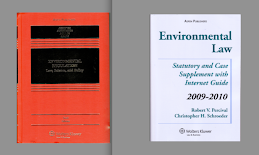
I have completed a Transition Guide describing all the significant changes in the new 8th edition of my casebook, Environmental Regulation: Law, Science & Policy, which was published by Wolters Kluwer at the beginning of February.  I am currently finishing a new Teacher’s Manual for the new edition, which will be available in time for professors using the new edition in their fall semester classes. 


Tomorrow I fly to the UK for the annual Colloquium of the IUCN Academy of Environmental Law, which is being held at Strathclyde University in Glasgow, Scotland.  One of the Academy’s most successful projects has been its “Training the Trainers” program in Asia.  I am featured in a new film produced by the Office of General Counsel of the Asian Development Bank's Law and Policy Reform Program that describes this program. The film is called "Developing Environmental Law Champions: Training-the-Trainers Program". It can be viewed by going to the ADB’s website at: https://www.teachenvirolaw.asia.

Sunday, April 8, 2018

Casebook 8th Edition, China Trip, IACHR, Juliana Case, German Cities Can Ban Diesel, U.S. Fuel Economy Rollback (by Bob Percival)

A lot has happened since my last blog post 11 weeks ago. I am delighted to report that the 8th edition of my environmental law casebook (Environmental Regulation: Law, Science & Policy) was published by Wolters Kluwer in early February.  The book is now available in bookstores and can be ordered online. I am finishing a new Teacher’s Manual for it that will be published shortly.

I spent spring break in China where I gave a lecture at Shanghai Jiaotong University.  Despite noting in my last blog post that air quality in Chine reportedly had improved, it was not at healthy levels during the week I was in Shanghai.  The mood among academia in China seems to have soured as the Communist Party expands its control over the academy, economy, and government with Xi Jingping now authorized to rule for life.  Although I am no fan of President Trump or tariffs, I agree with the conclusion that the U.S. needs to take a stronger stand against Chinese government restrictions on foreign investment, internet access and trade.

On March 29 I spoke at a conference at Emory University Law School sponsored by the Emory Corporate Governance and Accountability Review.  I spoke on “The Corporation and the Consumer: Responsible and Irresponsible Corporate Behavior.” As examples of irresponsible behavior I discussed the history of the lead industry, the asbestos industry, the tobacco industry, and the Volkswagen auto emissions scandal.  As examples of responsible corporate behavior I noted the increasing number of companies using independent auditors to ensure compliance with environmental and labor laws by their supply chains.  I also spoke to students in Emory’s masters program for Chinese lawyers about the state of environmental law in China.

In February 2018 the Inter-American Court of Human Rights released an advisory opinion first written in November declaring that the right to a healthy environment is fundamental to human existence.  The court’s opinion was issued in response to a request from Colombia.  The opinion declared that the right to a healthy environment is both an individual and collective right protecting both current and future generations.  The court declared that “[s]tates are obligated to prevent significant environmental damage[] within and outside their territory.” 

In the Juliana future generations climate litigation, which is before a federal district court in Oregon, on March 7, 2018, a panel of Ninth Circuit judges denied without prejudice the federal government’s motion for a writ of mandamus to stop discovery and a future trial. In re United States, 2018 WL 1178073 (2018). The court held that the federal government had not met the “high bar for mandamus relief” at this stage of the litigation.  It observed that it was “mindful that some of the plaintiffs’ claims as currently pleaded are quite broad, and some of the remedies plaintiffs seek may not be available as redress.” But the court left it for the district court to develop the record and to consider the claims raised by the plaintiffs. Plaintiffs are hoping for a trial to commence before the end of 2018.

On February 27 Germany’s Federal Administrative Court in Leipzig ruled that German cities have the legal authority to ban cars using diesel fuel in order to reduce air pollution in urban areas.  Automakers had argued that cities needed federal legislation expressly authorizing such bans, but the court disagreed.  Environmentalists hailed the ruling as providing an important tool to cities who are having a hard time complying with air pollution standards.  An excellent summary of the VW diesel defeat device scandal in the U.S. is provided in episode one of a new Netflix series called “Dirty Money.”

On April 2 EPA Administrator Scott Pruitt released a proposal to roll back U.S. fuel economy standards that require vehicles to average 38.3 miles per gallon in the 2018 model year, rising to 54.5 mpg by 2025. The standards, which are set jointly by EPA and the National Highway Transportation Safety Administration, were established in 2012 and reaffirmed just before the Obama administration left office in January 2017.  When the decision is finalized, it will trigger a massive legal battle with the state of California, which since 1970 has been authorized to adopt stricter motor vehicle emissions standards than the federal government.  Despite his rhetoric about giving states greater freedom, Pruitt is not inclined to do so for California.  He claims that California “should not be allowed to dictate” the nation’s standards, but it would not be doing so if it were allowed to retain a higher fuel economy standard.  Surprisingly, the document EPA released proposing this landmark change was devoid of analytical content and only 38 pages long, most of it cribbed from comments by automakers.  A legal battle is looming and EPA is not exactly arming itself well.


The Major League Baseball season has opened in the United States.  In South Korea air pollution forced the Korea Baseball Association to postpone three games.  The games had been scheduled to be held on April 6 in Seoul, Incheon, and Suwon. They were postponed because of high levels of fine dust in the air. “South Korean baseball league postpones games over smog,” Washington Post, April 7, 2018, at A7.

Sunday, January 21, 2018

2017 SECOND HOTTEST YEAR ON RECORD, TALKS OVER ETHIOPIAN DAM, CHERNOBYL SOLAR FARM, WILDLIFE TRAFFICKING KINGPIN ARRESTED (By Bob Percival)

NASA reported last week that the year 2017 was the second hottest year on record, bested only by 2016 when El Niño temporarily helped boost temperatures slightly.  Global average temperatures were 1.62 degrees Fahrenheit above the 1951-1980 average. The five hottest years on record have all occurred since 2010. Seventeen of the 18 hottest years have occurred since the year 2000.

Last month the World Bank announced that it no longer would provide funding for fossil fuel projects. This week the Conversation published an article by Professor Jason Kirk of Elon University noting that this decision represents the Bank showing a new found sense of independence from the United States, its largest funder, at a time when the Trump administration is promoting greater use of oil and gas. https://theconversation.com/signaling-more-independence-from-the-us-the-world-bank-phases-out-its-support-for-fossil-fuels-89497

Several sources report that there has been a noticeable improvement in air quality this winter in Beijing. The improvement in levels of fine particulates (PM2.5) is confirmed by data from the U.S. Embassy in Beijing.  Te-Ping Chen, Air Quality Improves in Beijing, Wall St. Journal, Jan. 18, 2018, at A6. PM2.5 levels in Beijing during the last quarter of 2017 dropped to 58 micrograms per cubic meter of air, a substantial drop from the year before, but still several times above the level the World Health Organization deems to be safe.  The improvement is attributed to stepped up inspections and fines against polluting factories in the provinces near Beijing, and cutbacks in coal use and steel production designed to meet environmental goals in the 5-year plan that expired at the end of 2017.

Egypt is protesting Ethiopia’s plans to fill the reservoir behind the Grand Ethiopian Renaissance Dam on the Nile River within three years of the project’s completion in 2019.  Egypt maintains that this will reduce the flow of the river to Egypt to levels that will cause it harm.  Ethiopian Prime Minister Hailemariam Desalegn held meetings with Egyptian officials in Cairo last week to discuss the conflict.  When completed, the da will be the largest in Africa.  Matina Stevis-Gridneff & Dahlia Kholaif, Egypt, Ethiopia Wrangle Over Nile Dam, Wall St. Journal, Jan. 18, 2018, at A9.

A Ukrainian firm, Rodina Energy Group, and a German company, Enerparc Ag, are building a solar energy farm in the exclusion zone around the damaged Chernobyl nuclear reactor.  They are expected to install 100 MW of solar generating capacity.  The site is seemingly ideal because it has easy access to the transmission lines that formerly carried power from the nuclear power plant that was irrevocably damaged in the 1986 accident.

Last week Coca Cola launched a “World Without Waste” campaign.  The company pledged that it will recycle all of its packaging by the year 2030. Chief executive James Quincey stated that “the world has a packaging problem - and, like all companies, we have a responsibility to help solve it.” Greenpeace was not impressed, http://www.bbc.com/news/business-42746911


Authorities in Bangkok arrested Boonchai Bach, who they allege is the mastermind of an international ring that smuggles endangered wildlife, including rhino horns.  The authorities allege than Bach operated the ring for more than a decades, reaping millions of dollars in revenue. Bach is alleged to have ties to Vixay Keosavang of Laos, who has been described as “the Pablo Escobar of wildlife trafficking.” Keosavang is still at large with a $1 million reward being offered by U.S. authorities for his capture.

Monday, January 8, 2018

Top Developments in 2017, Tax Cut Opens ANWR to Drilling, Prince Claus Awards (by Bob Percival)

Happy 2018.  I rang in the New Year while traveling on a plane to Israel.  On January 2 & 3 I participated in a Forum on Water Reuse, Food and Health at the Hotel Tzuba outside of Jerusalem.  The forum was part of the runup to the launching of a new joint Center on Water Reuse, Food & Health between the Hebrew University of Jerusalem and the University of Maryland.  The other U.S. participants included faculty from the School of Public Health, College of Agriculture & Natural Resources, and the College of Computer, Mathematical & Natural Resources. The participants from Hebrew University included faculty from the School of Agriculture, Food & Environment, the School of Public Health and the Department of Geography.  The Center will help coordinate multidisciplinary research on how to use water more efficiently in a similar fashion to the multidisciplinary

For the last several years I have sought to highlight in my first post of the year some of the top developments in Global Environmental Law during the previous year.  This year they include the following.  On June 1 Donald Trump announced that he intends to pull the U.S. out of the Paris climate Agreement.  With both Nicaragua and Syria deciding to join the agreement, the U.S. will become the only country in the world not participating in it.  Under the terms of the Paris Agreement the U.S. withdrawal cannot officially become effective until November 4, 2020, the day after the next U.S. presidential election.   Several states, cities, universities and companies responded by announcing that they were redoubling efforts to reduce their GHG emissions to signal the world that the U.S. could meet its initial Paris pledge even without the Trump administration.

The Trump administration also moved to shrink the size of national monuments, repeal the “waters of the U.S.” rule and EPA’s Clean Power Plan.  However, because it did not move to reverse EPA’s finding that GHG emissions endanger public health and welfare, EPA will remain under a legal obligation to control them. Overall the U.S. federal  government is moving sharply backwards on environmental protection, while the rest of the world continues to move forward.

Volkswagen pled guilty to criminal charges in the U.S. for its emissions testing scandal.  One VW executive was sent to jail, while several others are under indictment but unlikely to be extradited by Germany.   Sea Shepherd abandoned its annual efforts to harass the Japanese whaling fleet in Antarctica.  The Minimata Mercury Convention entered into force on August 16, 2017.  Both New Zealand and India granted legal personality to rivers. Climate litigation increased around the world, including lawsuits by Greenpeace against Statoil in Norway, the Juliana case in Oregon, a suit challenging construction of a coal-fired power plant in South Africa, and lawsuits in India, Australia, Colombia and Germany.  The Philippine Commission on Human Rights also launched a climate investigation. 

Decades of efforts by environmentalists to keep the Alaska National Wildlife Refuge ANWR closed to oil drilling were dealt a blow by tax cut legislation. On December 22, 2017, President Trump signed into law the Tax Cut and Jobs Act of 2017, which contains a provision opening ANWR to oil drilling.  The provision was added at the behest of Republican Senator Lisa Murkowski of Alaska, a long-time supporter of drilling ANWR in order to increase royalties to be received by the state of Alaska.  The bill passed the Senate by a vote of 51-48 under a “reconciliation” procedure that avoided the need to obtain 60 votes to overcome a filibuster.  It was argued that because the measure would raise revenue from oil royalties it was germane to the tax bill.  At a White House celebration following passage of the tax cut legislation, President Trump boasted that he had been able to overcome more than 40 years of opposition to opening ANWR and he congratulated Alaska’s long-time Congressman Donald Young, though calling him “Dan” by mistake. It will take considerable time before any drilling is done in ANWR and with oil prices much lower than in decades past, it is unclear how keen oil companies will be to drill there.

On December 6 I visited the Dutch Royal Palace in Amsterdam for the annual Prince Claus Awards.  The Prince Claus Fund gave its highest award to Chinese environmentalist Ma Jun and they asked me to write a tribute to him, which was published in the annual awards book.  More information about this event is provided in a blog post I have done for the blog of the American College of Environmental Lawyers (www.acoel.org) that will appear this week. 


On January 8 the U.S. Federal Energy Regulatory Commission (FERC) rejected efforts by Energy Secretary Rick Perry to require the provision of subsidies to coal-fired and nuclear power plants in the name of increasing the reliability of the electricity grid.

Sunday, December 3, 2017

U.S. Alone in Rejecting Paris as COP23 Concludes, ABA SEER, ACOEL, Maryland Clinic Summit (by Bob Percival)

The last two months have been so busy for me that I have not been able to find time to update the blog. During the 23rd Conference of the Parties (COP-23) to the UN Framework Convention on Climate Change, which was held in Bonn in November, both Syria and Nicaragua signed the Paris Agreement, leaving the U.S. as the only country in the world not to accept the agreement.  Although the Obama administration signed the Paris Agreement and deposited its instrument of acceptance to it, President Donald Trump on June 1, 2017 announced his intention to withdraw the U.S. from the agreement.  Under the terms of the Paris Agreement, this withdrawal cannot become effective until November 4, 2020, the day after the next U.S. presidential election.

On October 19th I spoke on a panel (“And Then There Were Nine”) about the Supreme Court and the environment at the fall meeting of the ABA’s Section on Environment Energy and Resources (SEER), which was held in Baltimore.  I discussed the Supreme Court’s June 2017 decision in Murr v. Wisconsin and prepared a paper analyzing the voting record of Supreme Court Justices on regulatory takings issues.  One striking finding of my paper was that Justice Anthony Kennedy has voted in the majority in all 10 regulatory takings cases in which he has participated.

On October 28, former DOJ Assistant AG John Cruden and I presented our annual Supreme Court review to annual meeting of the American College of Environmental Lawyers (ACOEL) in Charleston, South Carolina.  After the meeting concluded, my wife and I ventured out to the Isle of Palms to examine the property that had been owned by David Lucas in the Supreme Court’s landmark Lucas v. South Carolina Coastal Council case decided in 1992. Although Lucas had rejected the state’s conclusion that his beachfront property was endangered by sea level rise, it is now right at the edge of the ocean.  After the state bought out Lucas, they allowed two homes to be built on the properties.  Even though Hurricane Irma passed 200 miles to the west of Charleston, these homes were severely damaged by it and were boarded up when we visited them.  Meanwhile the Isle of Palms has been seeking millions of dollars from the Federal Emergency Management Agency (FEMA) for beachfront replenishment projects.

On November 10 I attended the wedding of a former student, Lori Schectel, in Palm Springs, California.  Lori now lives in San Francisco and is responsible for environmental permitting for Contra Costa County.  The day after the wedding I toured wind and solar energy farms north of Palm Springs which constitute a veritable museum documenting the development of improved renewable energy technologies over the last several decades.  When leaving Palm Springs I flew over the portion of the wind farms that also is being used to recharge the underground aquifer with some of the surplus runoff from last year’s drought-ending rainfall in California.  On November 20 I showed some of the photos I took of the aquifer recharge effort at a luncheon in Queenstown, Maryland for the multidisciplinary CONSERVE water reuse project I am involved in.  From November 30-December 3 I was back in California, touring Napa antd Sonoma to support the efforts of their wineries to recover from the fires.

On November 16 & 17 Maryland’s Environmental Law Program hosted a summit of U.S. environmental law clinics.  Representatives of thirty of the 62 U.S. environmental law clinics attended the conference.  The participants focused on how to improve collaboration among the clinics to maximize their impact.  The conference concluded with Georgetown environmental clinic director Hope Babcok delivering a stirring call to action.  Video of her presentation is available online at: http://video.law.umaryland.edu/OpenPlayer.asp?GUID=9BDE1BD2-F0DC-4FD1-9A41-240603328C5A

On Saturday November 18 I spoke on a panel on “Environmental Law Without Congress at the Federalist Society’s National Lawyers Convention in Washington, D.C.  I noted that virtually all the major federal environmental statutes had been passed by overwhelming, bipartisan majorities in Congress.  Now legislative gridlock has plagued environmental legislation, but bipartisan compromises produced laws comprehensively updating the Federal Insecticide, Fungicide and Rodenticide Act (FIFRA) in 1996 and the Safe Drinking Water Act during the same year.  I also reviewed the factors that contributed to the 2016 nearly unanimous adoption of the Frank Lautenberg Chemical Safety for the 21st Century Act in June 2016.  Video of my presentation is available online at: https://www.youtube.com/watch?v=7AJB4MTC3Ns

On Monday I am flying to Amsterdam for the Dutch royal family’s Prince Claus Fund awards, which will be presented at the Royal Palace on December 6.  Chinese environmentalist Ma Jun is winning one of the top awards and the Prince Claus Fund asked me to prepare a tribute to him.


Saturday, September 30, 2017

Hurricanes Caused Immense Environmental Damage, Minimata Convention Enters into Force, Nicaragua to Join Paris Climate Accord (by Bob Percival)

It has been two months since my last blog entry because I have been incredibly busy with both vacation and work.  In August my wife and I spent ten days in Iceland, including a week on a Wilderness Travel hiking expedition.  A slideshow of photos of our trip can be accessed online at: https://www.dropbox.com/s/d9288ispds64s3o/Iceland_August_2017_copy.m4v?dl=0The day after we returned from Iceland my son and I traveled to Oregon where we observed the total solar eclipse on August 21 from a hillside on a historic farm in the wine country south of Portland.  In September I have been working non-stop to prepare for fall classes (teaching Environmental Law to undergrads in College Park and to law students in Baltimore) and to finish some long-time research projects.  I have completed the manuscript for the new 8th edition of my casebook Environmental Regulation: Law, Science and Policy.  It has been four years since the seventh edition came out in 2013.  My editors report that I will be receiving page proofs shortly and the bound book should be in bookstores by early January 2018.

Three hurricanes have caused significant damage in Houston, Florida, Puerto Rico and the Virgin Islands. At the end of August Hurricane Harvey hit Houston. In early September Hurrican Irma hit the west coast of Florida, and in late Sepatember Hurricane Maria devastated Puerto Rico.  The hurricanes left substantial environmental damage in their wake, flooding oil refineries, chemical plants, and Superfund sites in Houston.  An Arkema chemical plant in Crosby, texas caught fire and released toxic air pollutants. ExxonMobil’s Baytown oi refinery, the second largest in the country, also was damaged, causing environmental releases of chemicals.  Compiling regulatory filings from oil refineries, chemical plants, and shale drilling sites, the Center for Biological diversity found that there had been releases of at least 1 million pounds of extra pollutants in the Houston area.  Chemicals released included benzene, 1,3 butadiene, hexane, hydrogen sulfide, sulfur dioxide, tolulene and xylene.  Air monitors from the Environmental Defense Fund in the Manchester neighborhood of Houston found up to 324 parts per billion of benzene, well above levels that require workers to wear breathing apparatus.

Scores of sewage treatment plants in the Houston area flooded and released raw sewage.  Sheila Kaplan and Jack Healy, Houston’s Floodwaters Are Tainted, Tests Show, N.Y. Times, Sept. 11, 2017. Testing of some floodwaters found “astonishing levels of E.coli in standing water in one family’s living room – levels 135 times those considered sage – as well as elevated levels of lead, arsenic and other heavy metals in sediment from floodwaters in the kitchen.” A few weeks before Harvey hit Houston, President Donald Trump has issued an executive order revoking an Obama administration directive that infrastructure projects receiving federal funds should conduct flood planning that takes into account rising sea levels from climate change.

On August 16, 2017, the Minimata Convention on Mercury entered into force. A total of 83 countries, including the U.S., have deposited their instruments of acceptance of the convention that seeks to lower global environmental releases of mercury. The first Conference of Parties to the Convention has just concluded in Geneva, Switzerland.

President Daniel Ortega told Nicaraguan state media that his government will join the Paris climate accord. Originally Nicaragua did not join the agreement concluded in December 2015 because Ortega said it did not require enough sacrifice from wealthy countries. Syria is now the only country that failed to join the agreement.  Rumors reported by EU climate negotiators that the Trump administration may reconsider its decision to withdraw from the Paris climate accord were forcefully denied on September 17 by Trump administration officials.  States iare now taking the lead in the U.S. in promoting efforts to reduce greenhouse gas emissions.  California is hanging tough even as the Trump administration considers relaxing fuel efficiency standards.  Northeastern states have strengthened their Regional Greenhouse Gas Initiative (REGGI).

In late August the NGO Sea Shepherd announced that it will no longer shadow the Japanese whaling fleet because the Japanese military was providing the fleet with data on the location of Sea SHepherd’s boats that made it easy for the whaling fleet to elude them.

The final report of the Australian Panel of Experts in Environmental Law (APEEL) is now online at: http://apeel.org.au  It consists of a Blueprint and eight technical reports sketching an ambitious vision for a new generation of environmental laws.

Even as the first Volwkswagen employees start to receive criminal sentences, a group of scientists has estimated that 38,000 people die prematurely each year due to diesel exhaust in excess of emission limits, see: https://www.theguardian.com/environment/2017/may/15/diesel-emissions-test-scandal-causes-38000-early-deaths-year-study

In late August a judge in Ecuador sentenced 20 Chinese fishermen to up to four years in jail for illegally catching 6,600 endangered sharks in Ecuador waters.

Kenya has passed the world’s toughest ban on the production, sale or use of plastic bags to reduce environmental pollution.  Penalties can range up to a $40,000 fine and four years in jail. See: https://www.theguardian.com/environment/2017/aug/28/kenya-brings-in-worlds-toughest-plastic-bag-ban-four-years-jail-or-40000-fine 

At the end of August a Brazilian judge suspended a decree From Brazilian President Michel Temer that would have opened up a vast nature reserve in the amazon to mining.  Judge Rolando Valcir Spanholo concluded thaqt the decree exceeded the President’s powers because only the Brazilian Congress could lift the protected status of the reserve.


U.S. Interior Department officials are moving to open up the Alaskan National Wildlife Refuge (ANWR) to seismic exploration to get a better idea of the size of the oil reserves contained there. Interior is also moving to shorten environmental impact assessments. An  August 31 memo from Interior Deputy Secretary David Bernhardt said EISs normally should not be more than 150 pages and take more than a year to prepare.